
Contractor's Guide • 2026
Indian Sandstone Paving UK: The Contractor's Complete Buyer's Guide
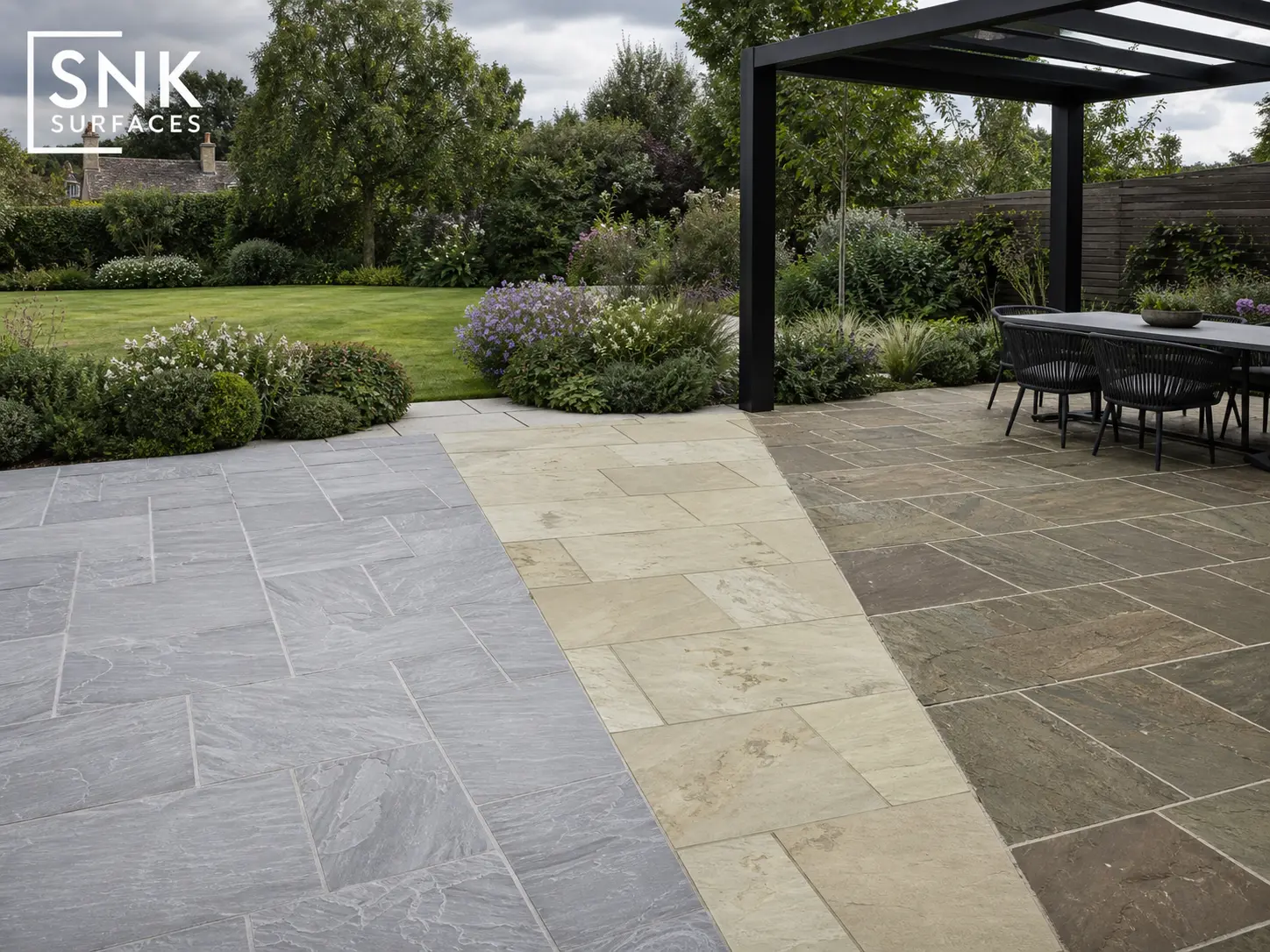
If you lay patios for a living in the UK, you already know that Indian sandstone paving is the most popular natural stone in British landscaping. It has been the go-to choice for over 20 years, and it is not going anywhere.
But here is the problem. Because Indian sandstone paving UK demand is so high, the market is flooded with cheap, poorly calibrated imports that crack after one winter and stain after one autumn. The stone itself is not the issue. The supply chain is.
This guide is written for UK landscape contractors, garden designers, and specifiers who want to get the material right the first time. We will cover the three main colour options, the two finishes that matter, how to check calibration before you buy, and the installation method that stops callbacks.
What Is Indian Sandstone and Where Does It Come From?
Indian sandstone paving is a sedimentary rock formed over millions of years from compressed layers of quartz sand and minerals. The high quartz content is what gives the stone its density and its ability to handle British frost without cracking.
The stone is quarried in two main regions of India, depending on the colour:
- Kandla Grey and Raj Green come from the Rajasthan region in northwestern India, primarily around the Bhilwara and Bundi districts.
- Fossil Mint comes from the Gwalior region in Madhya Pradesh in central India. This is the only area in the world where the specific geological conditions produced the pale cream and sage-green tones with natural manganese dendrite markings that make Fossil Mint so distinctive.
Understanding the origin matters because each region produces stone with different mineral compositions, different densities, and different colour profiles. A reliable Indian sandstone paving UK supplier should be able to tell you exactly which quarry seam your stone came from.
The Three Main Colours for UK Projects
There are three core colour families that dominate the Indian sandstone paving UK market. Each one suits a different style of garden and a different type of property.
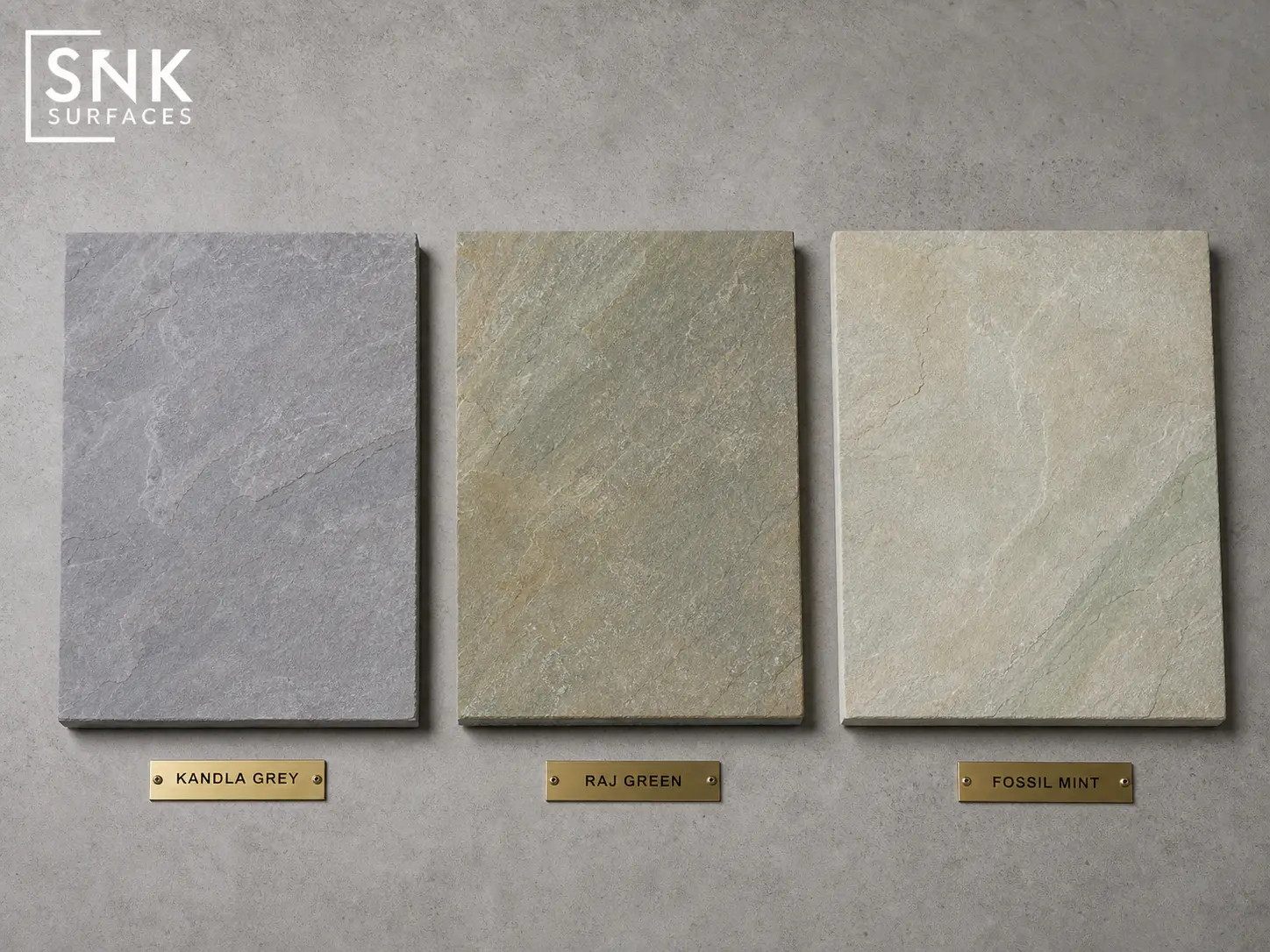
1. Kandla Grey Sandstone
This is the best-selling Indian sandstone paving colour in the UK, and for good reason. Kandla Grey offers cool silver and charcoal tones with subtle hints of pale blue and lavender that appear when the stone is wet. It pairs perfectly with modern anthracite bi-fold doors, black aluminium pergolas, and contemporary garden designs.
Kandla Grey is available in three finishes: traditional riven, antiqued tumbled, and smooth sawn-and-honed. This versatility makes it the most specified Indian sandstone paving UK contractors reach for on both modern and traditional projects.
Browse our full Kandla Grey Sandstone Paving range to see the colour options and available sizes.
2. Raj Green Sandstone
If your client wants a patio that looks like it has been there for a hundred years, Raj Green is the answer. It blends earthy olive greens, warm autumn browns, and soft greys in a way that closely mimics native British Yorkstone.
Raj Green is the traditional choice for period properties, cottage gardens, and heritage renovations. It looks particularly good alongside red brick walls, climbing roses, and mature hedging.
Explore our Raj Green Sandstone Paving collection for full specifications and trade pricing.
3. Fossil Mint Sandstone
Fossil Mint is the lightest and warmest of the three main colours. It features pale cream and ivory base tones with soft sage-green undertones and distinctive dark manganese dendrite markings that look like pressed fern leaves.
Because of its light colour, Fossil Mint reflects daylight beautifully and makes small or shaded UK gardens feel bright and open. It is the most popular choice for south-facing courtyards and family gardens.
View our complete Fossil Mint Sandstone Paving range, including matching bullnose steps, setts, cobbles, and walling bricks all cut from the same quarry block.
The Contractor's Buying Checklist: Three Things to Verify Before You Order
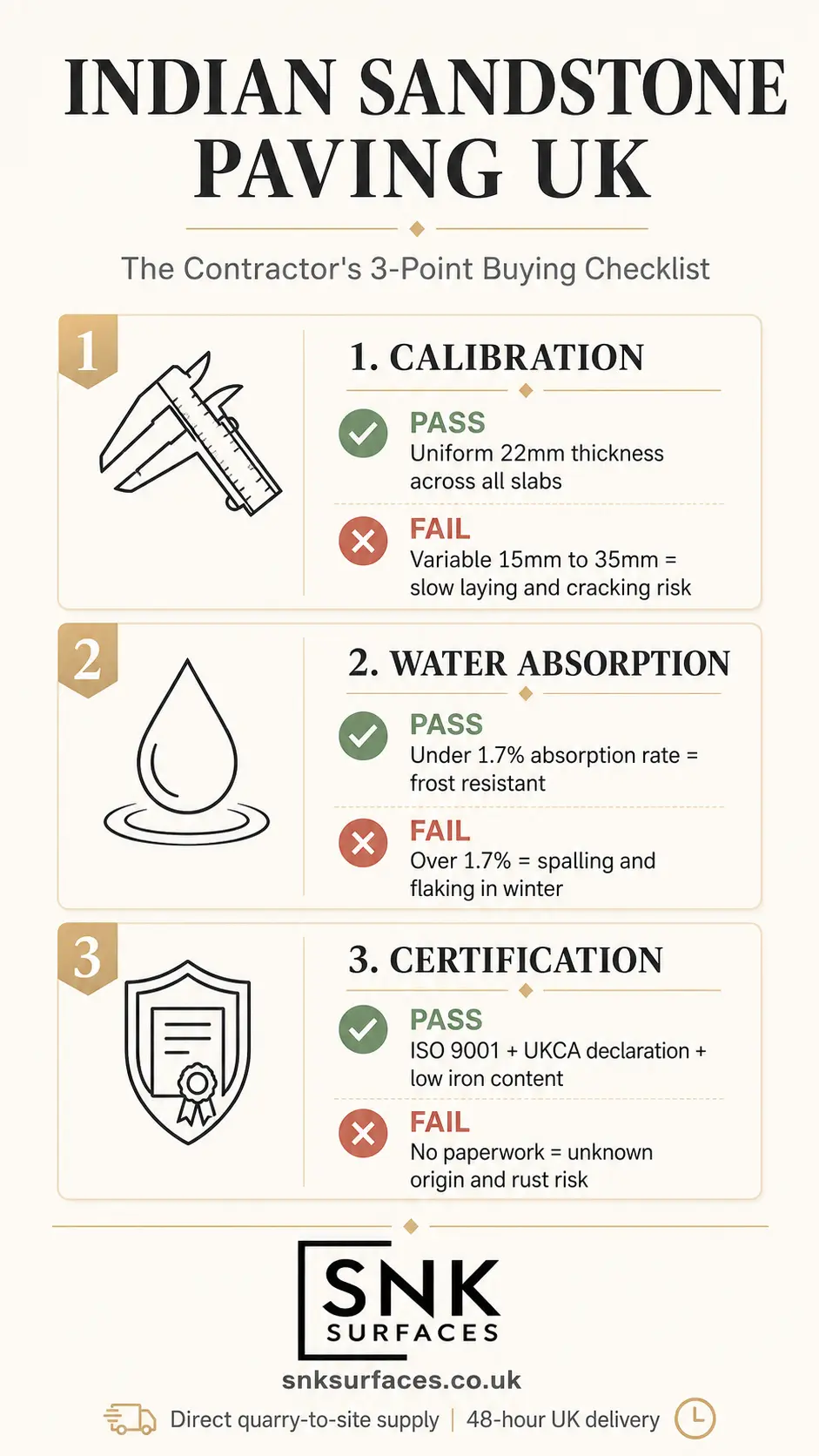
When you are ordering pallets of Indian sandstone paving UK suppliers deliver, the visual finish is only half the story. To protect your installation guarantee and avoid expensive callbacks, always verify these three technical factors before you sign the purchase order.
1. Check the Calibration (22mm Minimum)
Uncalibrated stone can vary from 15mm to 35mm in thickness within a single crate. This destroys your daily labour margin because your team has to constantly adjust the mortar bed depth under every individual slab.
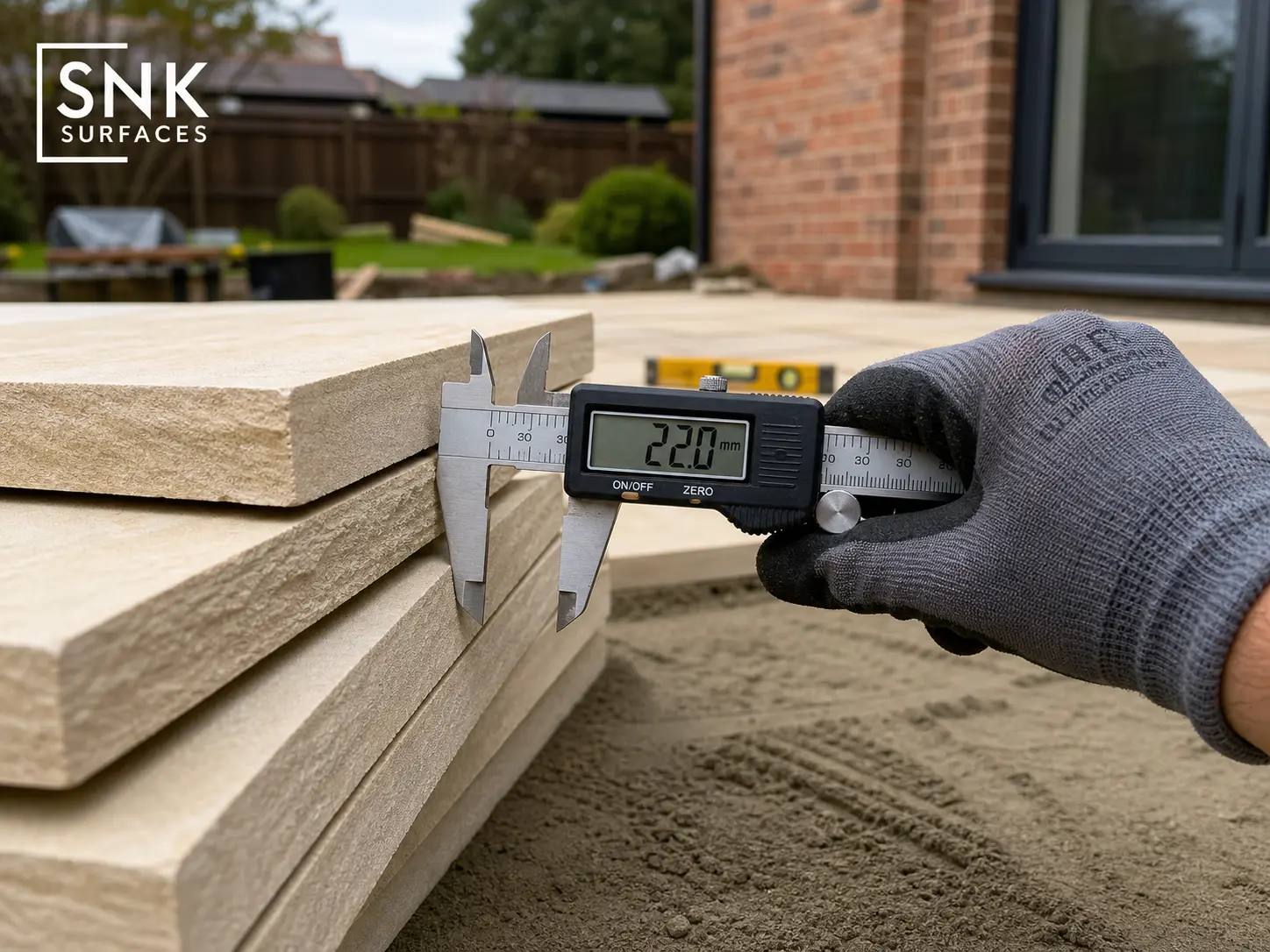
Always specify 22mm calibrated Indian sandstone paving. Machine-calibrated slabs have a uniform thickness that lets your team lay faster, use less mortar, and achieve a perfectly level surface. Under BS 7533 paving standards, consistent thickness tolerances are essential for uniform load distribution across the sub-base.
2. Check the Water Absorption Rate
Frost is the biggest enemy of natural stone in the UK. When porous stone absorbs rainwater and the temperature drops below zero, the trapped water freezes and expands by 9%. This internal pressure causes the surface to flake, spall, and crack.
Look for test data confirming a water absorption rate below 1.7%. This proves the stone is dense enough to survive decades of British freeze-thaw cycles. High-density quartzitic Indian sandstone paving UK suppliers provide will easily meet this threshold when sourced from the correct quarry seams.
3. Check for Iron Content and Ethical Certification
Some cheaper quarry seams contain high levels of natural iron ore. When this stone gets wet in a UK garden, the iron oxidises and produces ugly brown and orange rust stains across the surface within six months.
A reputable Indian sandstone paving UK supplier will provide ISO 9001 certification for their manufacturing facility and full UKCA declarations of performance. This proves the stone has been tested to BS EN 1341 standards and sourced from low-iron quarry seams.
Finishes: Riven vs Sawn-and-Honed
Your choice of surface finish affects both the look of the garden and the slip safety of the patio.
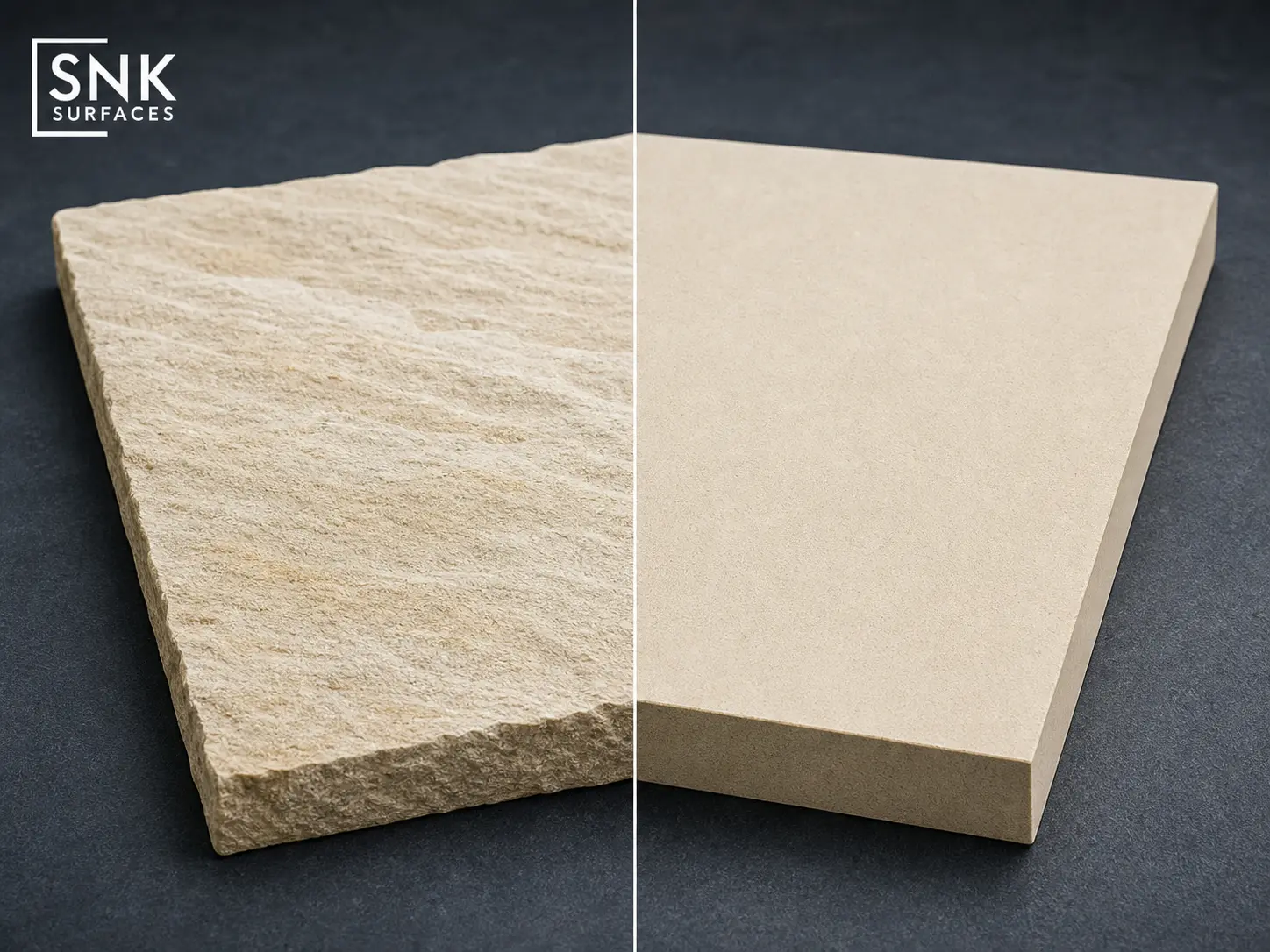
Traditional Riven (Natural Cleft)
The stone is hand-split along its natural bedding planes, leaving a gently textured, undulating surface with hand-dressed edges. Riven Indian sandstone paving provides excellent natural grip underfoot and easily meets HSE slip resistance guidelines for outdoor wet conditions. It is the safest and most popular choice for family gardens and areas around swimming pools.
Sawn-and-Honed
The stone is machine-cut with diamond blades on all six sides, then ground flat on top to create a smooth, matte surface. This finish allows ultra-tight 3mm to 5mm grout joints and gives you a sleek, contemporary look that rivals porcelain. Sawn-and-honed Indian sandstone paving UK projects tend to suit modern new-build homes and seamless indoor-outdoor living spaces.
BS 7533 Installation: How to Prevent Callbacks
The vast majority of natural stone patio failures have nothing to do with the stone itself. They are caused by poor groundwork and incorrect bedding methods. If you want to stop staining and prevent slabs from lifting, follow these three rules.
Rule 1: Never Spot Bed
Spot bedding (the "dot and dab" method) is the fastest way to ruin an Indian sandstone paving UK installation. It leaves empty voids beneath the slab where water collects. As the moisture evaporates upward through the porous stone, it carries minerals with it and creates ugly brown mortar rings on the surface.
Rule 2: Use a Full Mortar Bed
Lay every single slab on a full, continuous wet bed of 4:1 sharp sand and cement mortar, roughly 30mm to 40mm deep. There must be zero empty voids beneath the stone. Compact a minimum of 100mm MOT Type 1 aggregate sub-base underneath the mortar bed.
Rule 3: Apply SBR Slurry Primer
This is the step that separates professional installations from amateur ones. Indian sandstone paving is moderately porous on its underside and will not create a strong mechanical bond with standard mortar alone.
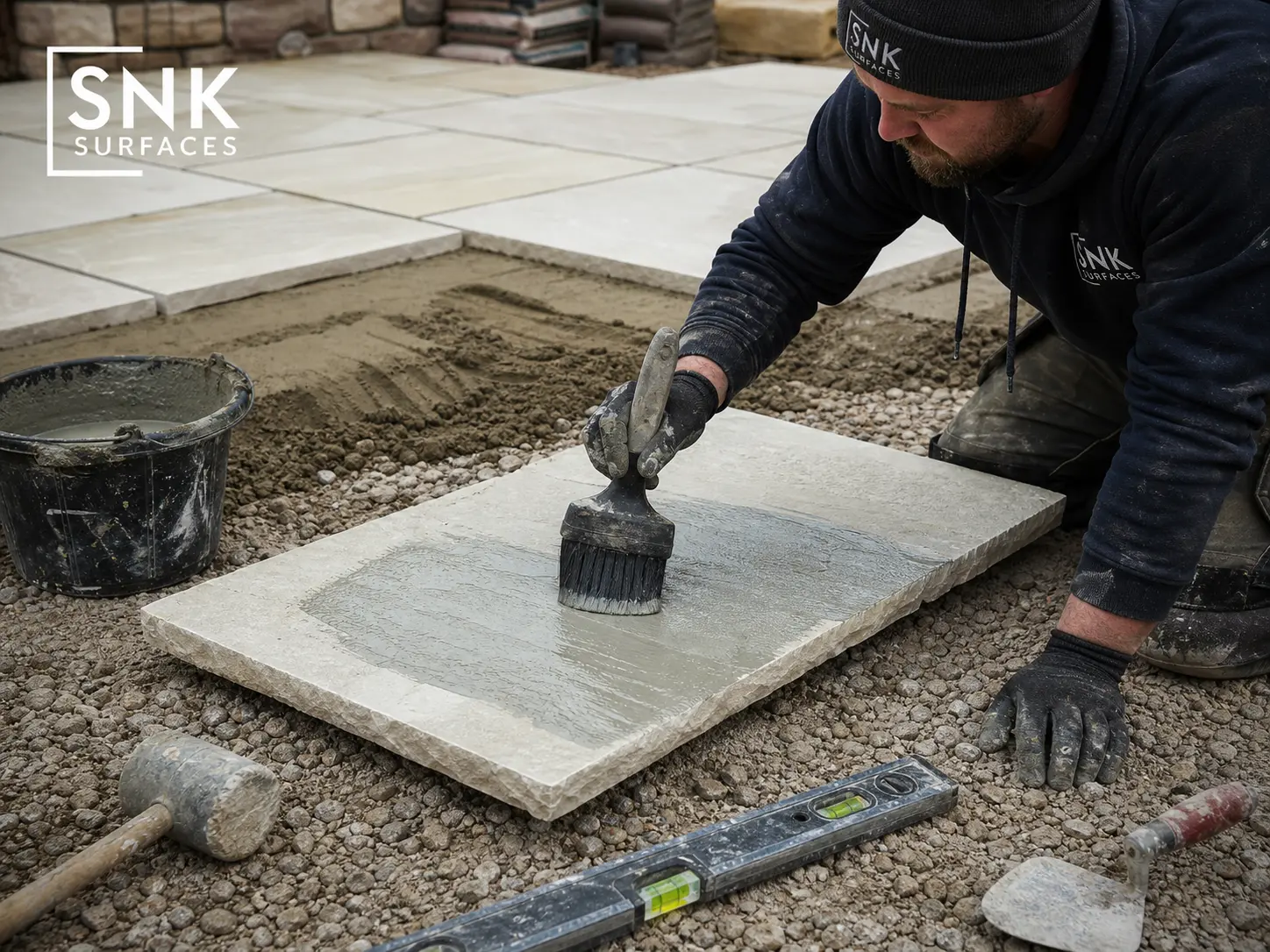
You must paint the entire underside of every slab with a polymer-modified SBR slurry primer immediately before placing it on the wet mortar. The primer creates a permanent chemical bond and stops ground salts from rising to the surface as white efflorescence stains.
Indian Sandstone Paving vs Outdoor Porcelain
Many clients will ask you to compare natural stone against modern outdoor porcelain. Here is the simple breakdown.
If your client wants a zero-maintenance, highly uniform surface that resists all stains without sealing, direct them to 20mm outdoor vitrified porcelain paving. Porcelain absorbs less than 0.5% water, requires no sealant, and will look identical in 20 years to the day it was laid.
If your client wants authentic, organic character with natural colour variation that blends into a traditional garden setting and develops a beautiful weathered patina over time, Indian sandstone paving UK remains the more cost-effective and visually warm choice.
For a detailed side-by-side comparison across eight performance factors, read our complete Porcelain vs Sandstone Paving UK guide.
Buy Direct From the Manufacturer
When you buy Indian sandstone paving UK builders' merchants sell, the stone has likely passed through a quarry broker, an export agent, and a UK distributor before reaching you. Every step adds a markup to your final invoice and reduces your control over quality.
At SNK Surfaces, we own our quarry relationships in Rajasthan and Gwalior, and we process the stone at our own manufacturing facility in Morbi, Gujarat. We ship directly to our UK warehouse and deliver to your project site within 48 hours. No middlemen, no mixed batches, no 8-week container wait times.
Every crate we supply is labelled with the quarry seam and batch number, so you can order matching stock for extensions months or even years later.
Frequently Asked Questions
1. What is the best thickness for Indian sandstone paving UK projects?
For residential patios and pedestrian pathways, 22mm calibrated thickness is the industry standard. It provides the structural strength needed to handle British frost and foot traffic while ensuring fast, uniform installation. Never use 15mm uncalibrated stone for outdoor UK applications.
2. Does Indian sandstone get slippery when wet?
No. Traditional riven Indian sandstone paving has a naturally textured cleft surface that provides excellent grip underfoot. It comfortably meets HSE slip resistance guidelines for low slip potential in wet outdoor conditions.
3. Why is my Indian sandstone patio turning green?
Natural stone is porous and will attract surface algae in damp, shaded UK gardens. Prevent this by sweeping away wet autumn leaves weekly and applying a breathable impregnating stone sealer 4 to 6 weeks after installation.
4. Should I seal my Indian sandstone patio?
Sealing is strongly recommended. A water-based impregnating sealer like Lithofin MN Stain-Stop protects the porous stone from barbecue grease, red wine spills, and leaf tannins. It also makes routine cleaning much easier.
5. How do I clean an Indian sandstone patio?
Wash the stone with warm soapy water and a stiff bristle brush. You can use a pressure washer once a year on a low-fan setting, keeping the nozzle at least 30cm from the surface to avoid damaging the jointing. Never use acid-based brick cleaners on natural sandstone.
6. Can I get matching steps and walling for my Indian sandstone patio?
Yes. Our Fossil Mint Sandstone range includes matching bullnose steps, tumbled setts, decorative cobbles, and bespoke walling bricks, all cut from the same quarry block for perfect colour consistency.
The Bottom Line
Indian sandstone paving UK contractors choose remains the most versatile, cost-effective, and visually appealing natural stone for British gardens. The key to a successful project is sourcing calibrated 22mm stone from a direct manufacturer, verifying low iron content and water absorption rates, and installing on a full mortar bed with SBR slurry primer.
Get those three things right and your patios will last for decades without callbacks.
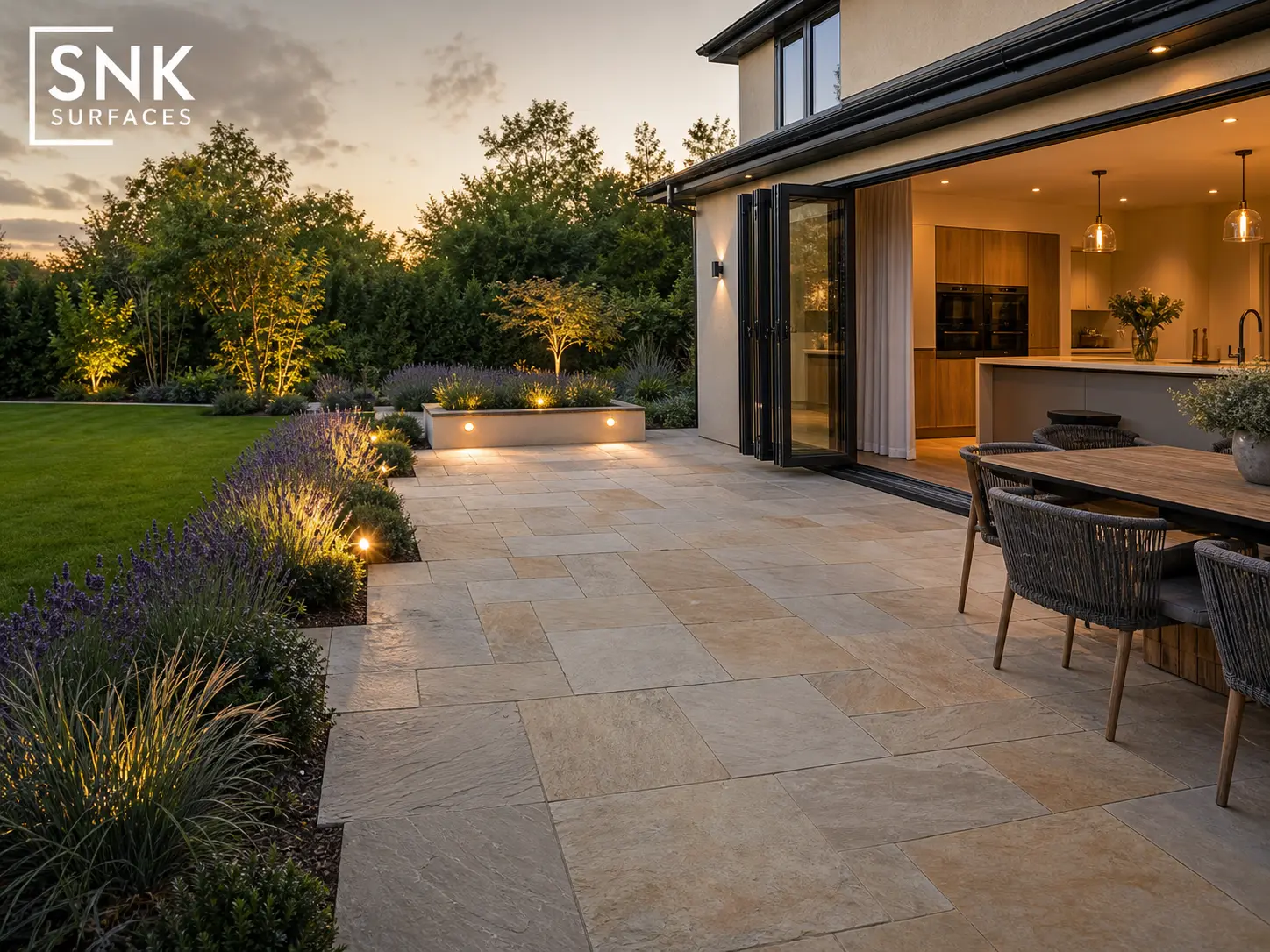
Ready to order for your next project?
Browse our complete Indian sandstone paving ranges or request a free trade sample box delivered to your UK site. Contact the SNK Surfaces team at snksurfaces.co.uk for direct-from-quarry pricing and 48-hour nationwide delivery.