
Contractor Guide • 2026
Kandla Grey Porcelain Paving: The Complete UK Trade Guide
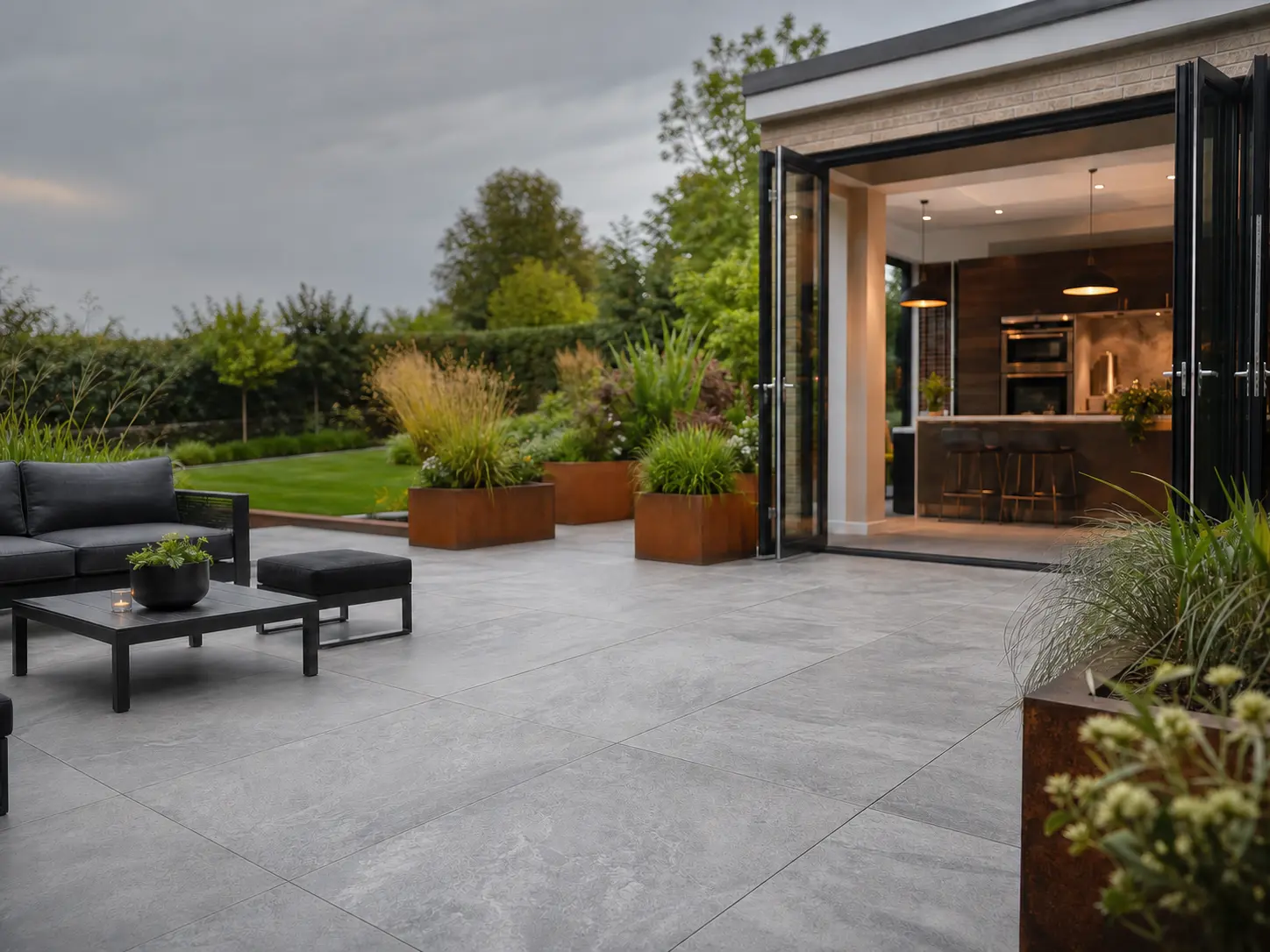
Natural Indian sandstone has dominated British garden design for over 20 years. But something has shifted in the last five years. UK homeowners and commercial clients are asking for the same natural stone look with none of the maintenance headaches.
That demand is exactly why kandla grey porcelain paving has become one of the fastest-growing specifications in UK hard landscaping.
If you are a landscape contractor or garden specifier, you already know the conversation. Your client wants the cool silver-grey tones of natural Kandla stone. But they do not want to spend their weekends power-washing algae or reapplying chemical sealers every 18 months.
This guide breaks down everything you need to know about kandla grey porcelain paving for UK projects. We will cover how it replicates natural stone, the technical specs that matter on site, the best applications, and a step-by-step installation guide that complies with BS 7533 British paving standards.
Quick Answer
Kandla grey porcelain paving is a 20mm vitrified outdoor tile engineered to replicate the exact colour and texture of natural Kandla Grey sandstone. Fired at over 1,200 degrees Celsius, it achieves a water absorption rate below 0.5 percent, making it 100 percent frost-proof, stain-resistant, and immune to algae growth. It carries a certified R11 slip rating for wet-weather safety and requires zero chemical sealers over its entire lifespan.
The Story Behind the Name
The name "Kandla Grey" comes from a specific geological seam of natural sandstone quarried in the Rajasthan region of northwestern India. For two decades, natural Kandla Grey Sandstone Paving has been the best-selling grey stone in the UK market. Its cool silver tones, subtle charcoal banding, and occasional hints of ice blue complement British weather and modern anthracite window frames perfectly.
But natural stone has a built-in weakness. It is porous. It absorbs water, stains, and algae. And UK buyers love the colour but hate the upkeep.
The solution was kandla grey porcelain paving. Manufacturers took the exact colour profiles, tonal variations, and surface textures of the natural stone and engineered them into a vitrified ceramic body. The result is a tile that looks like natural sandstone but performs like modern engineering.
If your client cannot decide between the two, our detailed porcelain vs sandstone comparison guide covers the full 8-point technical breakdown.
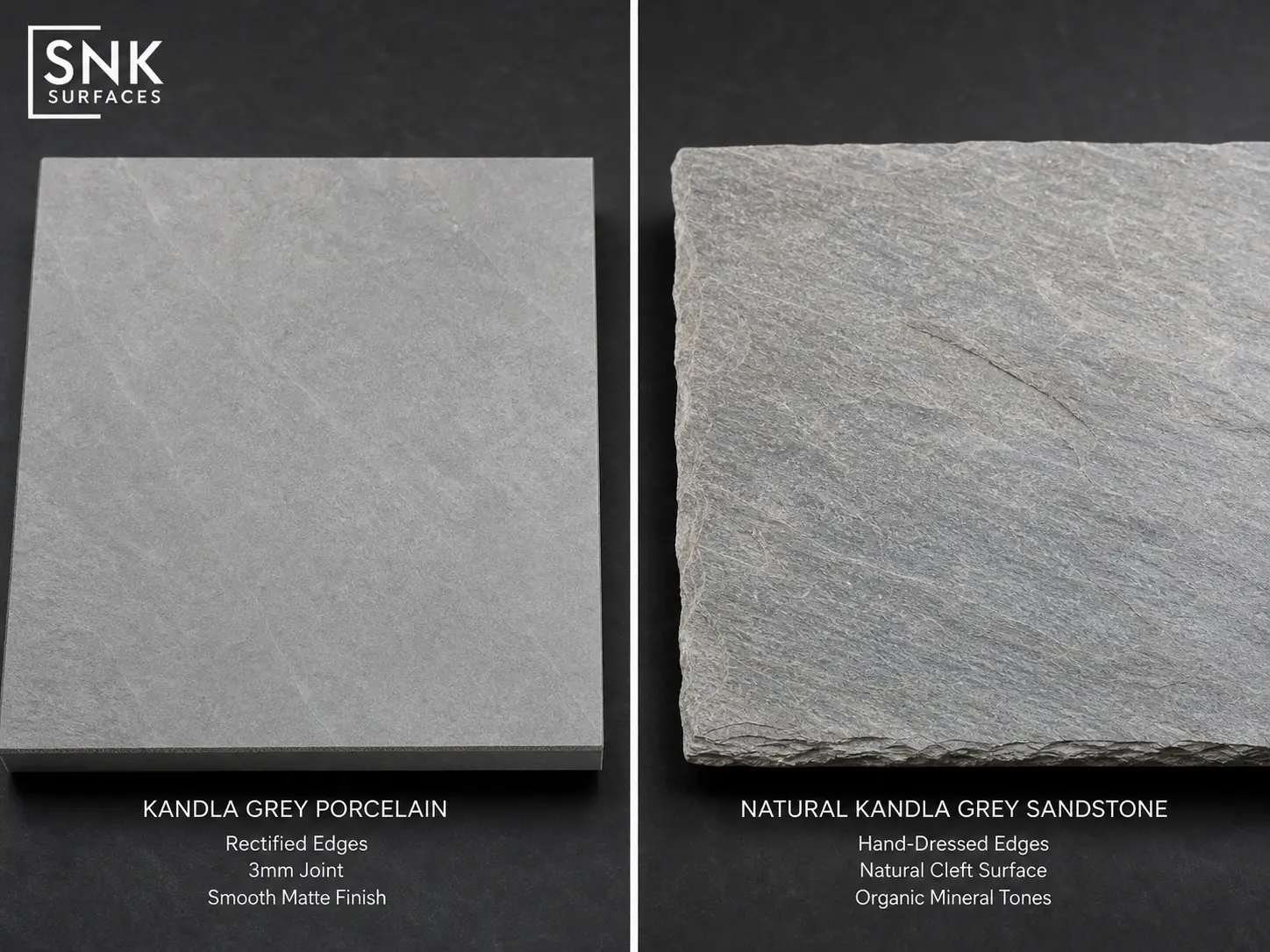
How Kandla Grey Porcelain Paving Replicates Natural Stone
Ten years ago, outdoor porcelain looked like cheap bathroom tiles. The patterns were flat, the surface was shiny, and every slab looked identical. It was easy to spot from a distance.
The technology behind kandla grey porcelain tiles today is completely different.
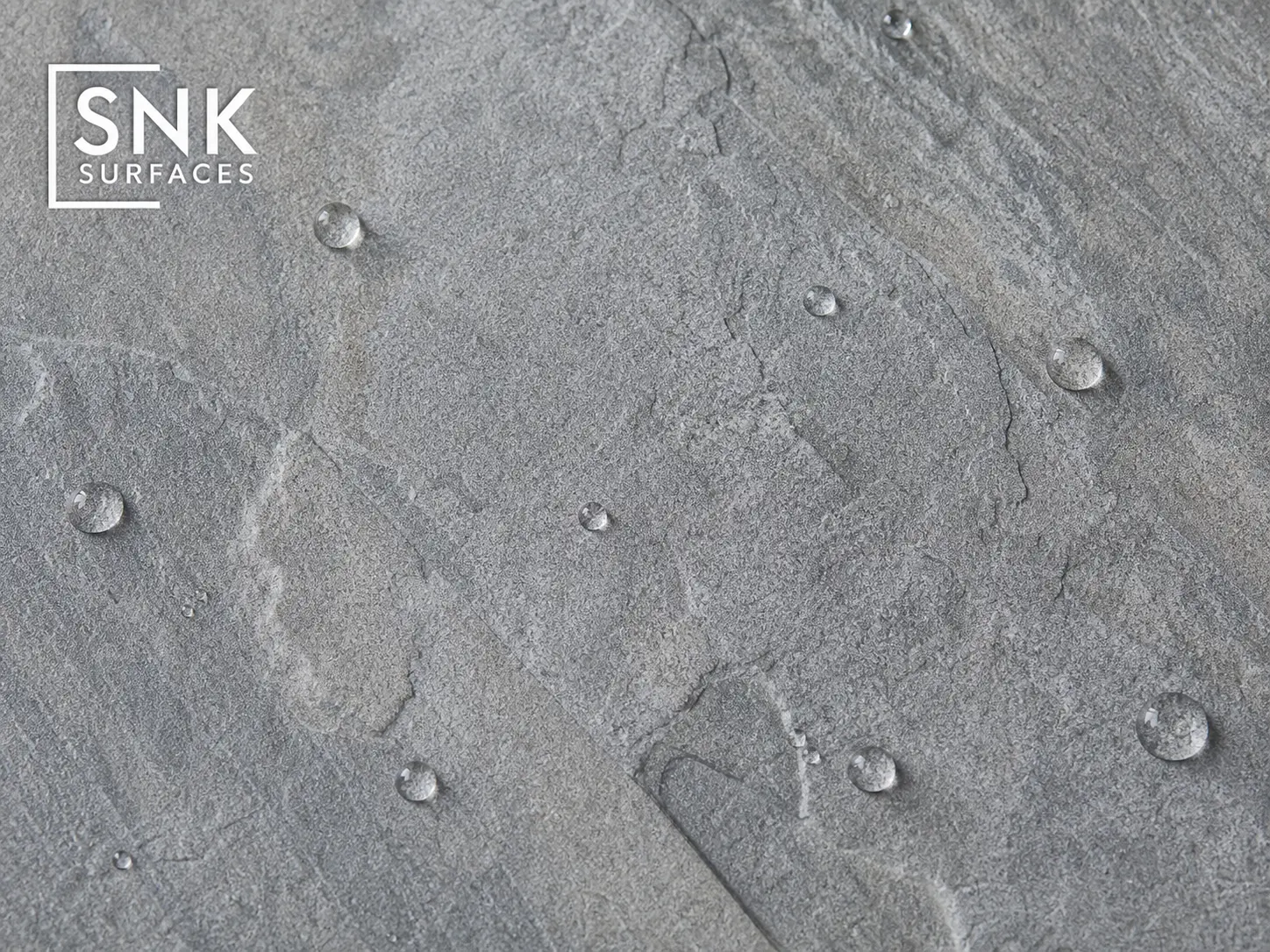
Modern manufacturers use high-definition 3D digital printing. They take ultra-high-resolution scans of the best pieces of natural Indian sandstone, capturing every quartz vein, every fossil mark, and every subtle colour shift. That data is printed directly onto the raw porcelain clay before it enters the kiln.
The Importance of Multiple Faces
A key specification to check when ordering kandla grey porcelain paving is the number of "faces" in the batch. A face is a unique printed pattern. Premium suppliers provide 20 to 30 different faces per batch.
This means when you lay a 50 square metre patio, the human eye cannot spot a repeating pattern. The finished surface has the same random, organic variation as natural stone dug from the ground.
The surface is not flat either. The manufacturing process presses a subtle micro-texture into the top of each tile. When you run your hand over kandla grey smooth porcelain, you can feel the artificial riven clefts and textured grain. It looks real because it feels real.
Technical Advantages Over Natural Stone
The aesthetic of kandla grey porcelain paving mimics natural stone. But its technical performance is where it pulls ahead for UK contractors and commercial specifiers.
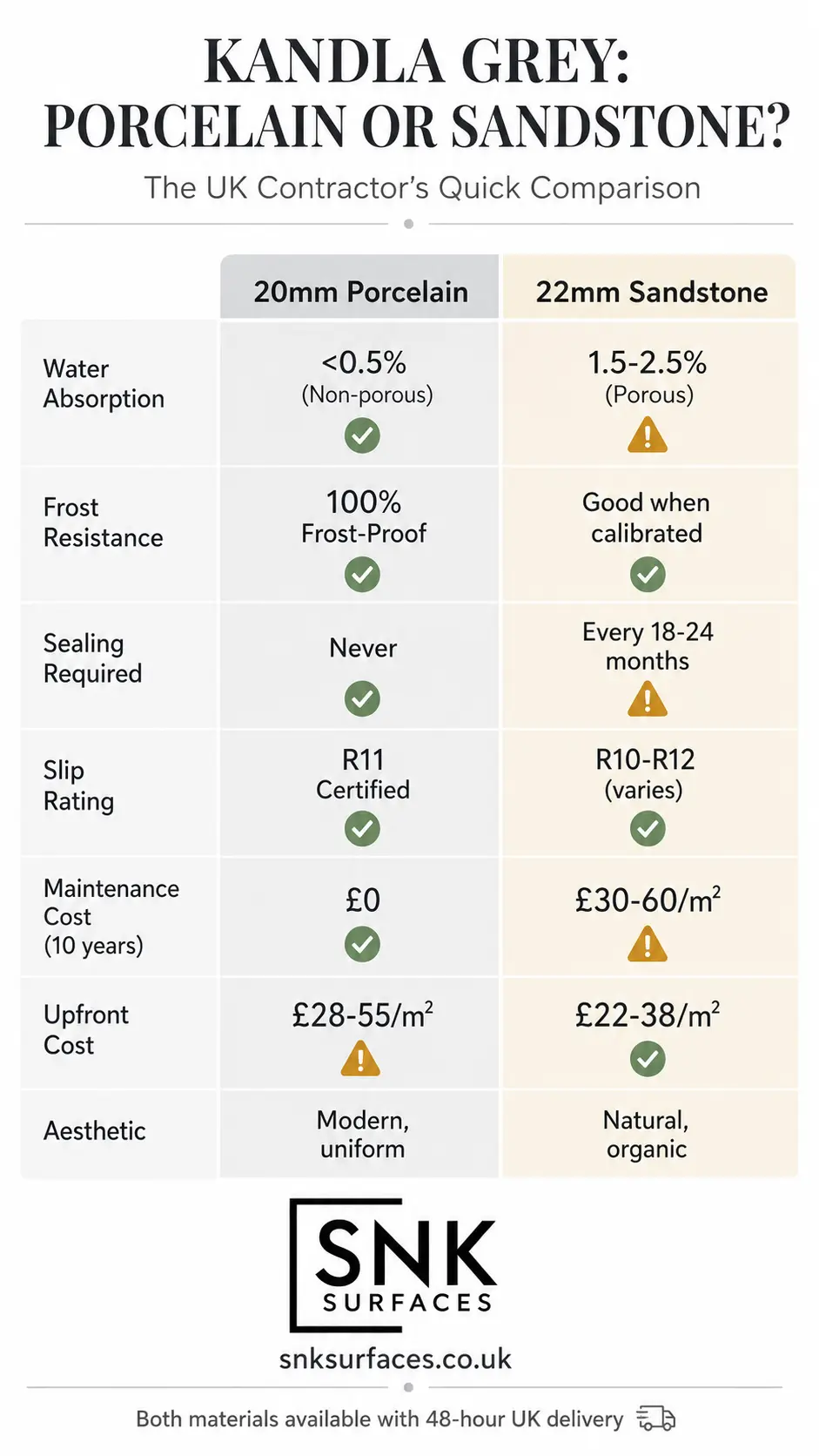
1. Zero Porosity and 100 Percent Frost Resistance
Natural sandstone absorbs between 1.5 and 2.5 percent of its weight in water. When that water freezes inside the stone during a British winter, it expands by 9 percent and causes the surface to flake and crack.
Kandla grey porcelain paving is vitrified at 1,200 degrees Celsius. This fuses the clay particles into a glass-like internal structure with a water absorption rate below 0.5 percent. Water physically cannot enter the tile. No water inside means no freeze-thaw damage. Ever.
2. Zero Sealing Required
Natural stone needs chemical sealers reapplied every 18 to 24 months to prevent stains from barbecue grease, red wine, and leaf tannins. Kandla grey porcelain tiles require no sealant whatsoever. Spill anything on the surface and it wipes away with warm soapy water.
3. Algae and Moss Cannot Take Root
In damp, shaded UK gardens, natural stone turns green within a single winter as algae colonises the pores. Because kandla grey porcelain paving has no pores, algae and moss have nothing to grip. A simple sweep and an annual wash keeps silver porcelain paving slabs looking new for decades.
4. Superior Compressive Strength
Despite being only 20mm thick, vitrified outdoor porcelain has a breaking strength exceeding 13,000 Newtons. This makes kandla grey porcelain paving suitable for high-traffic commercial terraces and areas with heavy point loads from planters and furniture.
5. UV-Stable Colour
Natural stone fades and weathers over time as UV light and acid rain break down the surface minerals. The HD print on kandla grey porcelain tiles is baked into the ceramic body during firing. It is 100 percent UV stable. The patio will look identical in 20 years to the day it was laid.
Best Applications for Kandla Grey Porcelain Paving
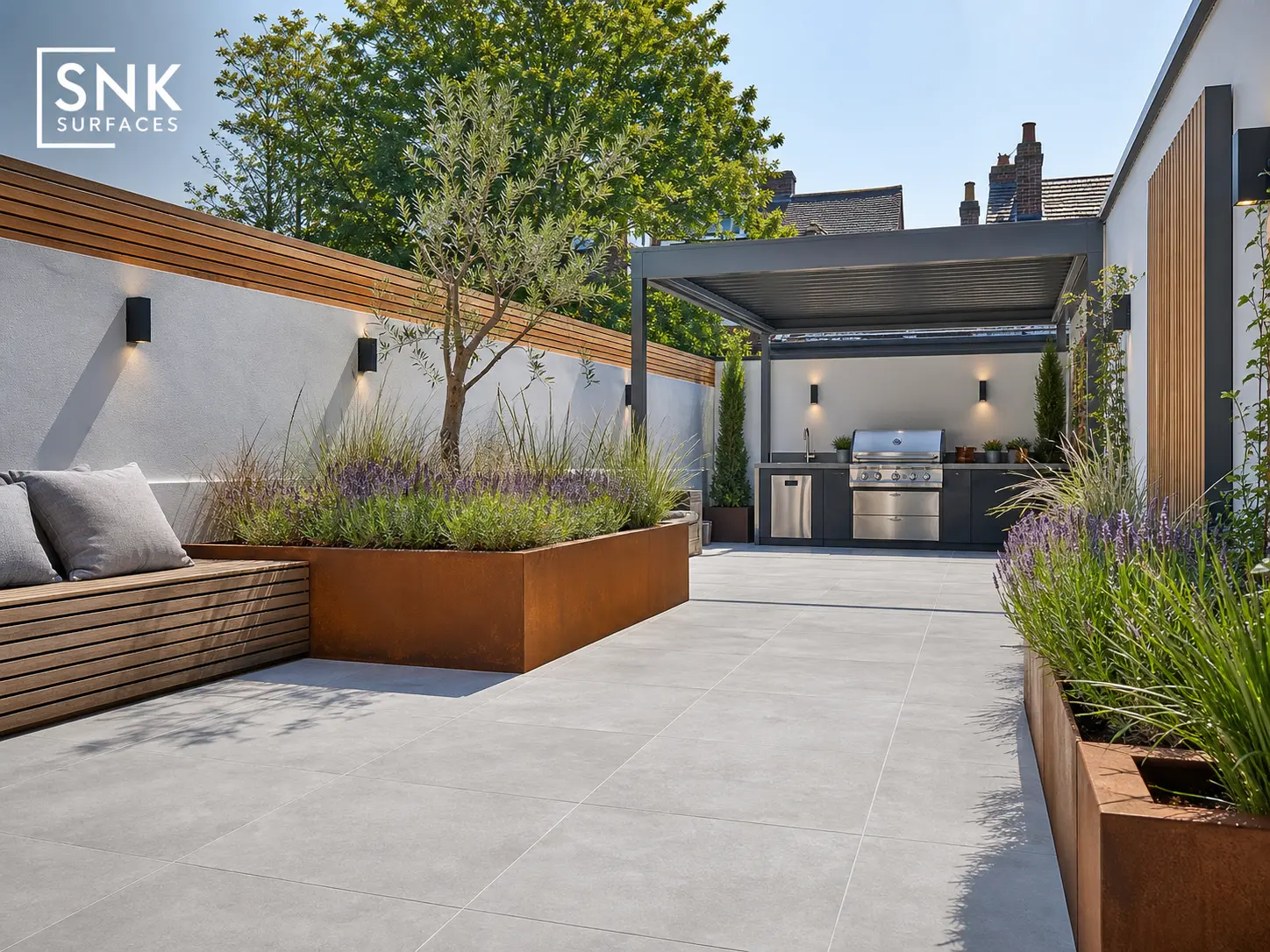
Contemporary Garden Patios
Modern UK homes increasingly feature open-plan kitchens with large aluminium bi-fold doors. Homeowners want the outdoor patio to look like a seamless extension of the indoor floor. Kandla grey porcelain paving is ideal for this. Its rectified machine-cut edges allow ultra-tight 3mm grout joints, creating a clean, unbroken surface that flows from kitchen to garden.
Urban Roof Terraces and Balconies
Weight is the biggest constraint on roof terraces and balconies. A heavy mortar bed and thick natural stone can exceed structural limits.
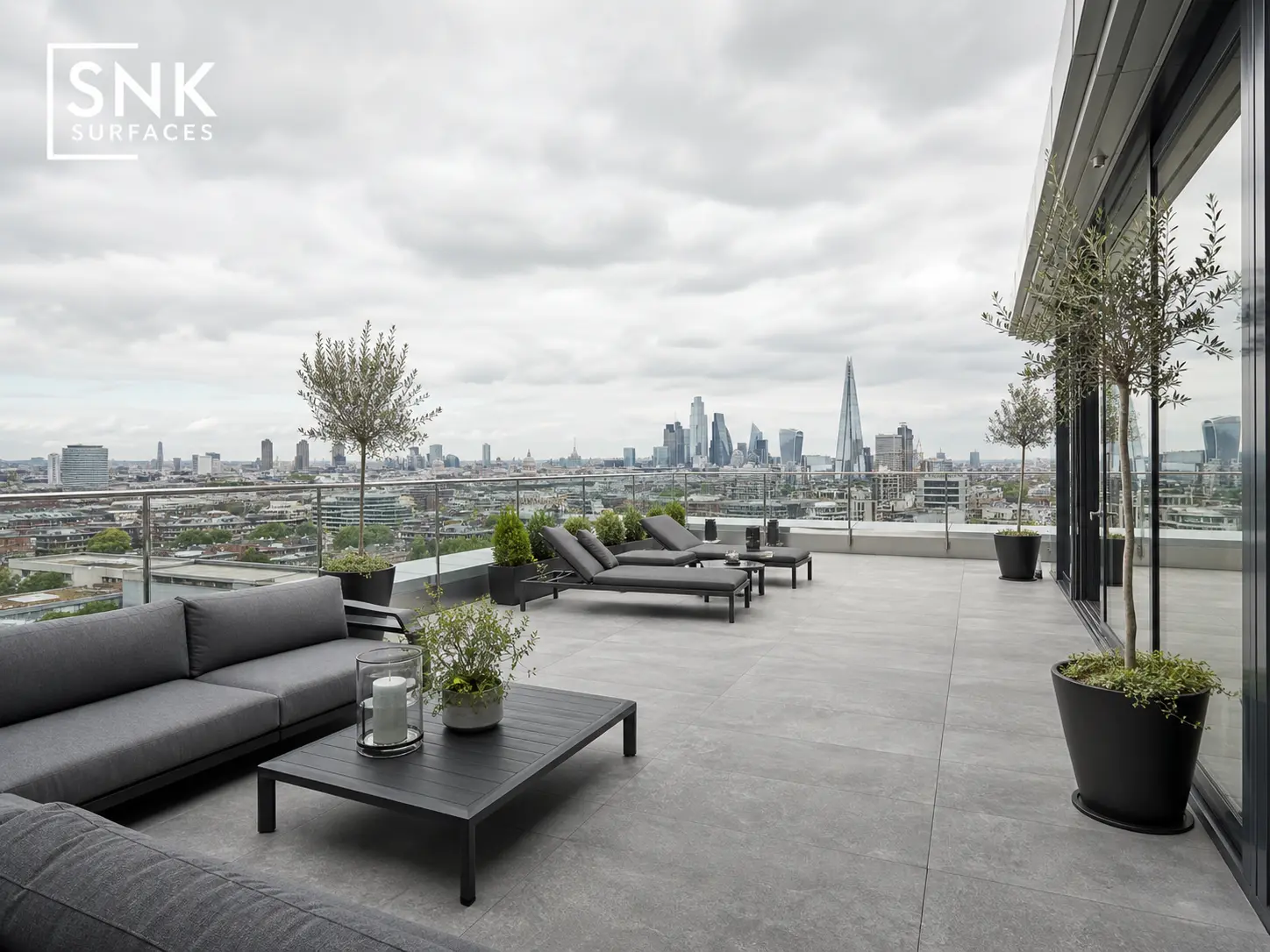
Kandla grey porcelain paving at 20mm thickness is lightweight enough to install on adjustable plastic pedestal systems. This dry installation method adds minimal weight, hides drainage pipes beneath the floor, and allows rapid installation without wet mortar.
Commercial Outdoor Spaces
Pub beer gardens, restaurant terraces, and office courtyards endure heavy daily foot traffic, spilled drinks, and aggressive cleaning routines. Natural stone in these environments stains and degrades quickly.
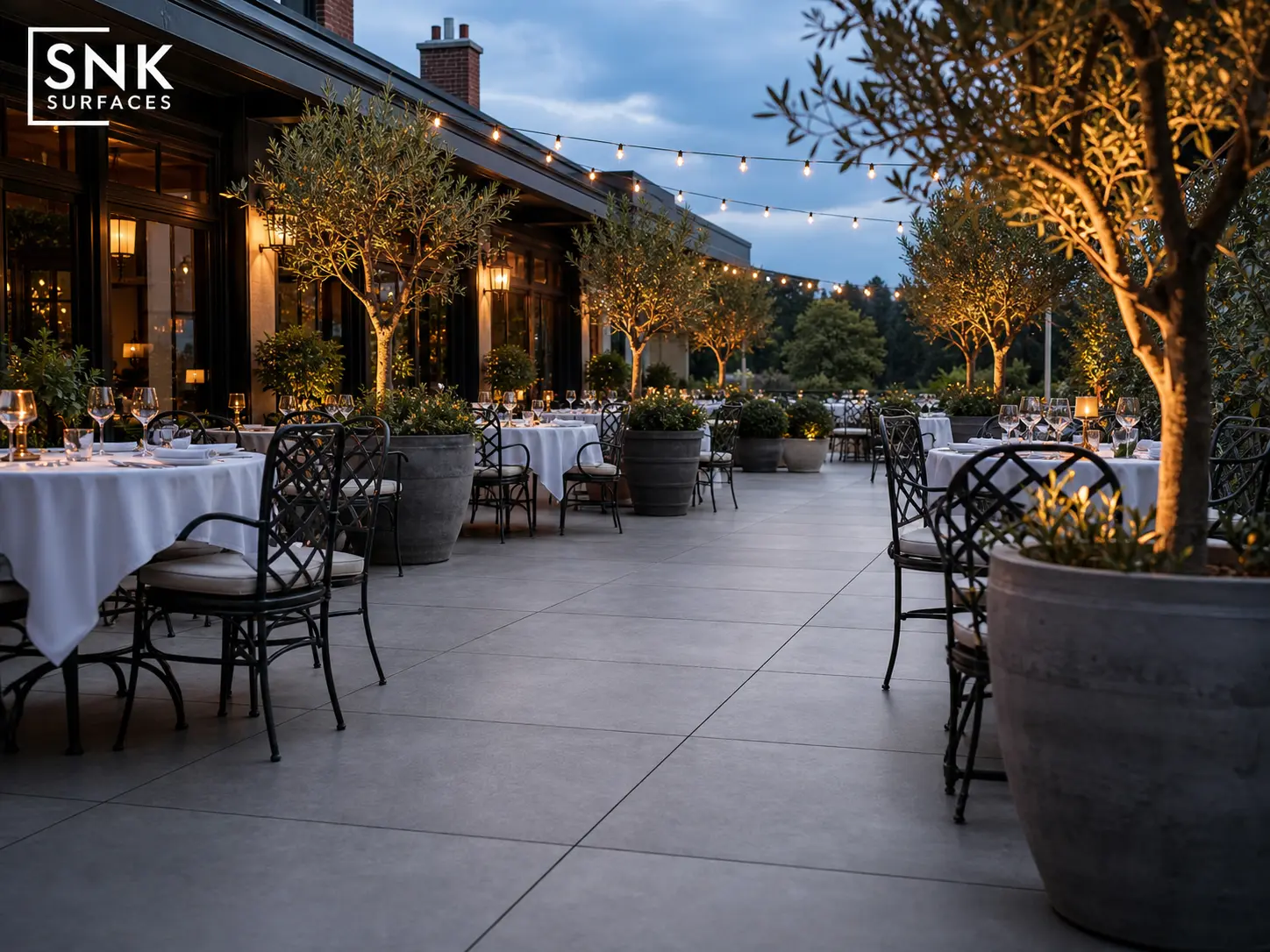
Grey porcelain patio slabs UK businesses specify can handle daily pressure washing and chemical cleaning without any surface damage or colour loss.
Installation Guide for UK Contractors
Laying kandla grey porcelain paving requires a different approach from natural stone. Because the tile is completely non-porous on its underside, it will not bond to standard mortar on its own. Skip the primer and your tiles will de-bond within months.
Follow these five steps to ensure a permanent, BS 7533 compliant installation.
Step 1: Sub-Base Preparation
Excavate the area and lay a geotextile weed membrane. Install a minimum of 100mm to 150mm of MOT Type 1 aggregate. Compact in 50mm layers using a heavy vibrating plate compactor until the base is completely solid and level.
Step 2: Full Mortar Bed
Never use spot bedding or dot-and-dab on porcelain. This leaves voids under the tiles where water collects and causes cracking. Lay a full, continuous 30mm to 40mm bed of wet 4:1 sharp sand and cement mortar across the entire laying area.
Step 3: SBR Slurry Primer (Critical)
This is the single most important step when installing kandla grey smooth porcelain.
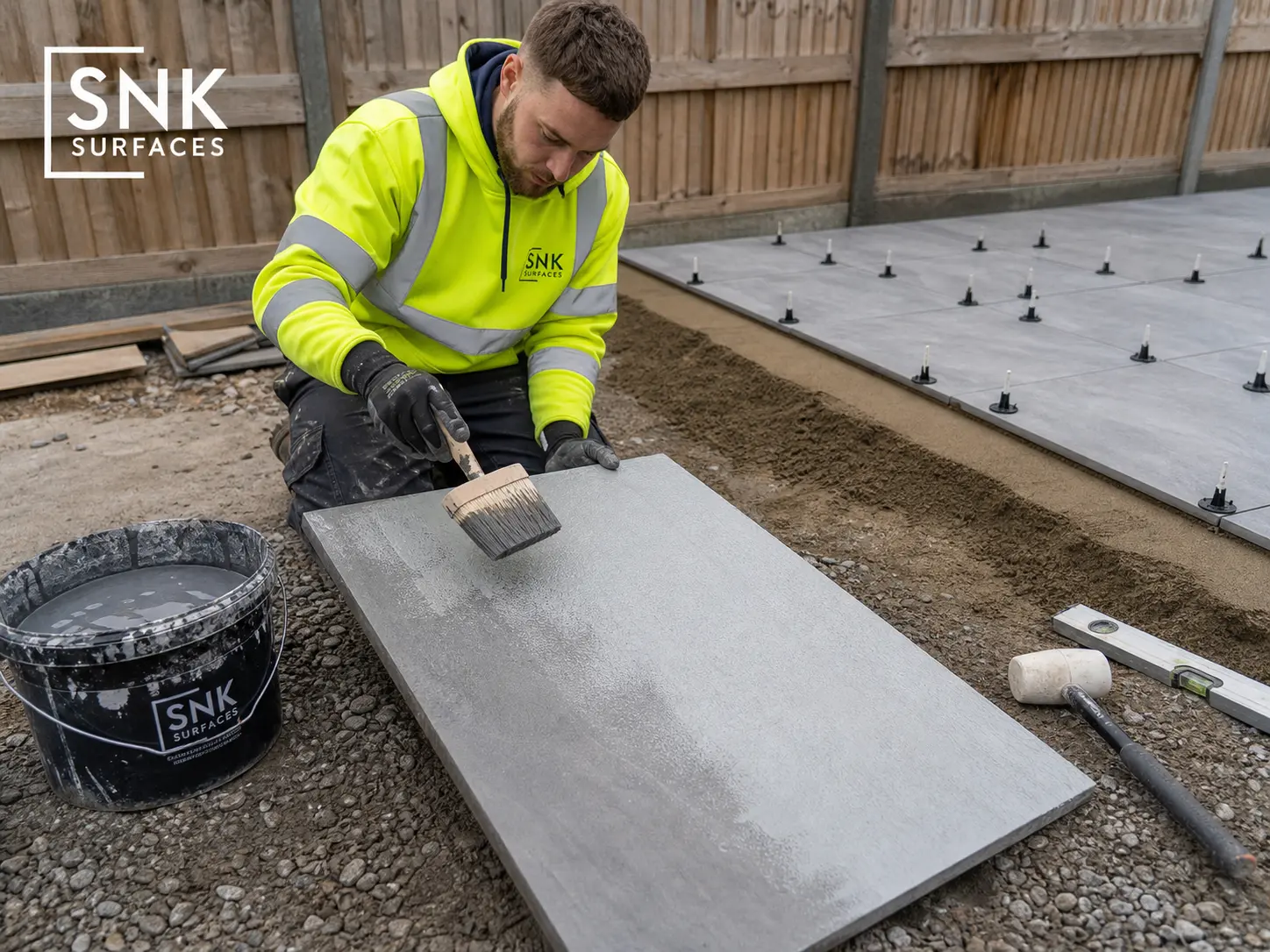
Paint the entire underside of every tile with a polymer-modified SBR slurry primer immediately before placing it on the wet mortar. The primer creates a chemical bond between the non-porous tile and the cement bed. Without it, the installation will fail.
Step 4: Jointing and Grouting
Because kandla grey porcelain tiles have rectified machine-cut edges, you can achieve narrow 3mm to 5mm joints. After the mortar cures for 24 to 48 hours, fill the joints with an exterior-grade flexible porcelain grout. Do not use standard sand-and-cement pointing in narrow joints, as it will crack and crumble. Clean the tile surface with a damp sponge before the grout dries.
Step 5: Drainage Falls
Kandla grey porcelain paving achieves a certified R11 slip rating under HSE wet slip resistance guidelines, making it safe for UK rain. However, water does not drain through the tile like it does with porous stone. Build a minimum 1:60 gradient into your mortar bed so rainwater runs off the surface and into a drainage channel.
Frequently Asked Questions
1. Is kandla grey porcelain paving slippery when wet?
No. Premium kandla grey porcelain paving carries a certified R11 anti-slip rating under DIN 51130 and achieves PTV 36+ under the HSE pendulum test. The micro-textured matte surface provides reliable grip in wet UK conditions.
2. Does grey porcelain paving fade in sunlight?
No. The colour and pattern on kandla grey porcelain tiles are baked into the ceramic body at over 1,200 degrees Celsius. They are 100 percent UV stable and will never fade, bleach, or discolour.
3. Do I need to seal kandla grey porcelain tiles?
No. Vitrified porcelain has a water absorption rate below 0.5 percent. Stains and water cannot penetrate the surface, so chemical sealants are unnecessary and will actually create a cloudy film if applied.
4. How do you cut kandla grey porcelain paving?
Porcelain is extremely dense. You must use a continuous-rim diamond blade on a wet saw or angle grinder. Standard masonry blades will overheat and chip the edges. Allow extra time per cut compared to natural sandstone.
5. How do you clean silver porcelain paving slabs?
Sweep regularly and wash with warm water and a mild pH-neutral detergent. You can use a pressure washer on a low-fan setting, keeping the nozzle at least 30cm from the grout joints.
6. Is porcelain paving more expensive than natural sandstone?
The upfront material cost of kandla grey porcelain paving is slightly higher than mid-range natural sandstone. But when you factor in 20 years of sealing, cleaning, and maintenance costs for natural stone, porcelain is the cheaper option over the lifetime of the patio.
The Bottom Line
Kandla grey porcelain paving gives UK contractors the best of both worlds. Your clients get the cool silver-grey aesthetic of Britain's favourite natural stone. You get a material that is frost-proof, stain-proof, algae-proof, and requires zero callbacks for maintenance issues.
The key to a successful installation is the groundwork. Use a solid sub-base, a full mortar bed, and never skip the SBR slurry primer. Get those three things right and the patio will outlast the building it sits next to.
Ready to specify Kandla Grey for your next project?
Browse our full range of Kandla Grey Porcelain Paving for trade pricing, custom sizes, and 48-hour UK delivery direct from the manufacturer. Or explore the natural stone alternative with our Kandla Grey Sandstone Paving collection.