
Buyer's Guide • 2026
Porcelain vs Sandstone Paving: Which Is Best for UK Gardens in 2026?
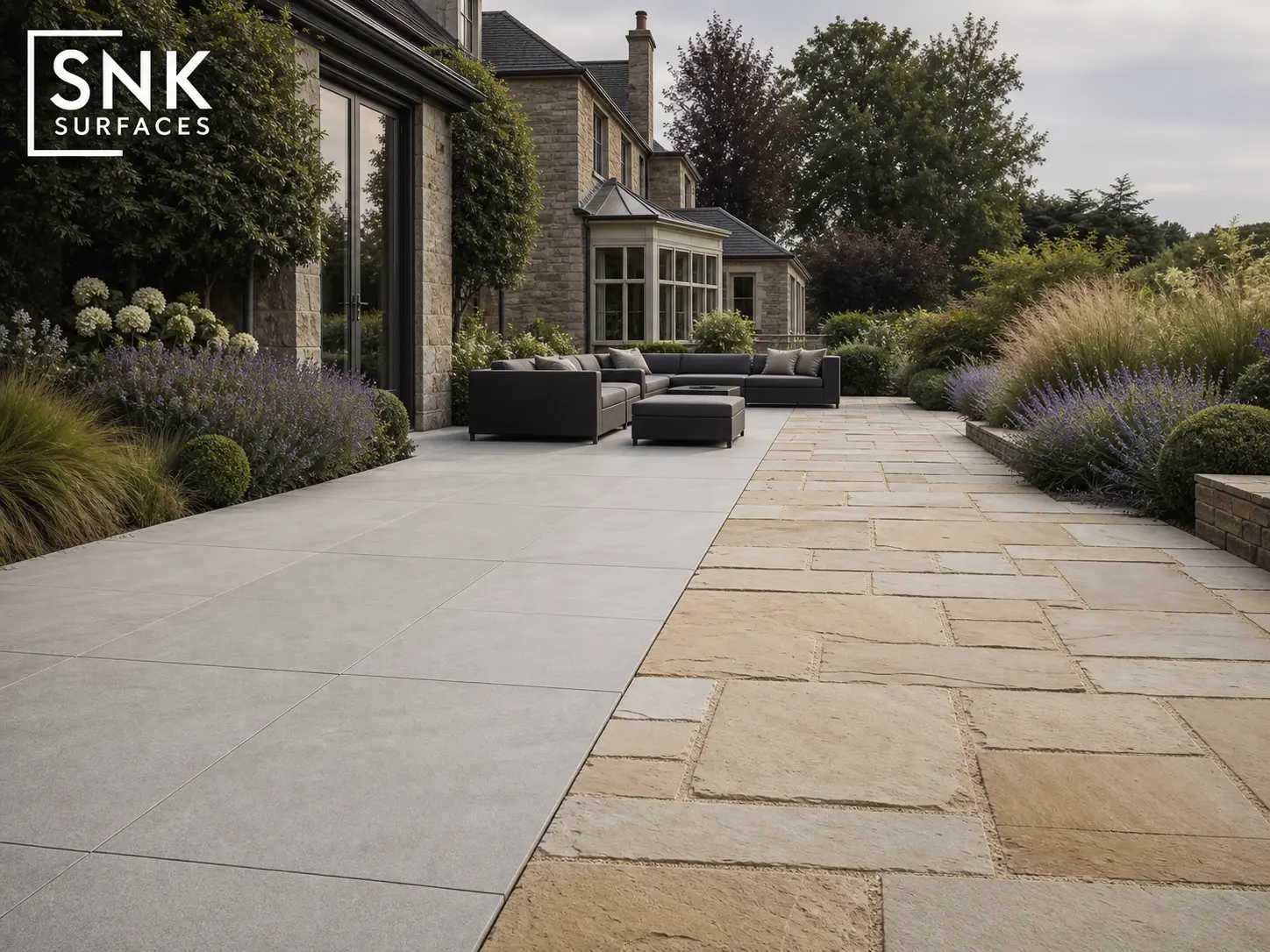
If you are a landscape contractor, garden designer, or homeowner planning a patio in the UK, you have probably already hit the same wall everyone hits: should I go with porcelain or sandstone?
Five years ago, this was not really a debate. Natural Indian sandstone was the default choice for almost every UK patio, and porcelain was something you used in bathrooms. But 20mm outdoor porcelain has changed the game. It is now specified on everything from suburban garden renovations in Surrey to commercial roof terraces in Manchester.
Both materials look fantastic when laid properly. Both handle British weather reasonably well. But they perform very differently when it comes to maintenance, slip resistance, installation cost, and how they look after ten years of rain, frost, and BBQ grease.
This guide cuts through the marketing fluff and gives you an honest, side-by-side comparison of porcelain vs sandstone paving across the eight factors that actually matter on UK job sites. No bias we sell both, so we have no reason to push one over the other.
The quick answer: If your client wants a sleek, modern patio that will look identical in 20 years with zero maintenance, go with porcelain. If they want the warm, natural character of real stone and are happy with a bit of seasonal upkeep, go with sandstone. If they want both, you can mix them more on that later.
1. Cost: What You Actually Pay (Upfront and Over 10 Years)
This is where most buyers get misled. They compare the pallet price of porcelain vs sandstone and assume sandstone is cheaper. It is upfront. But the real cost picture looks different when you factor in installation and ten years of maintenance.
Upfront material cost (trade prices, ex VAT):
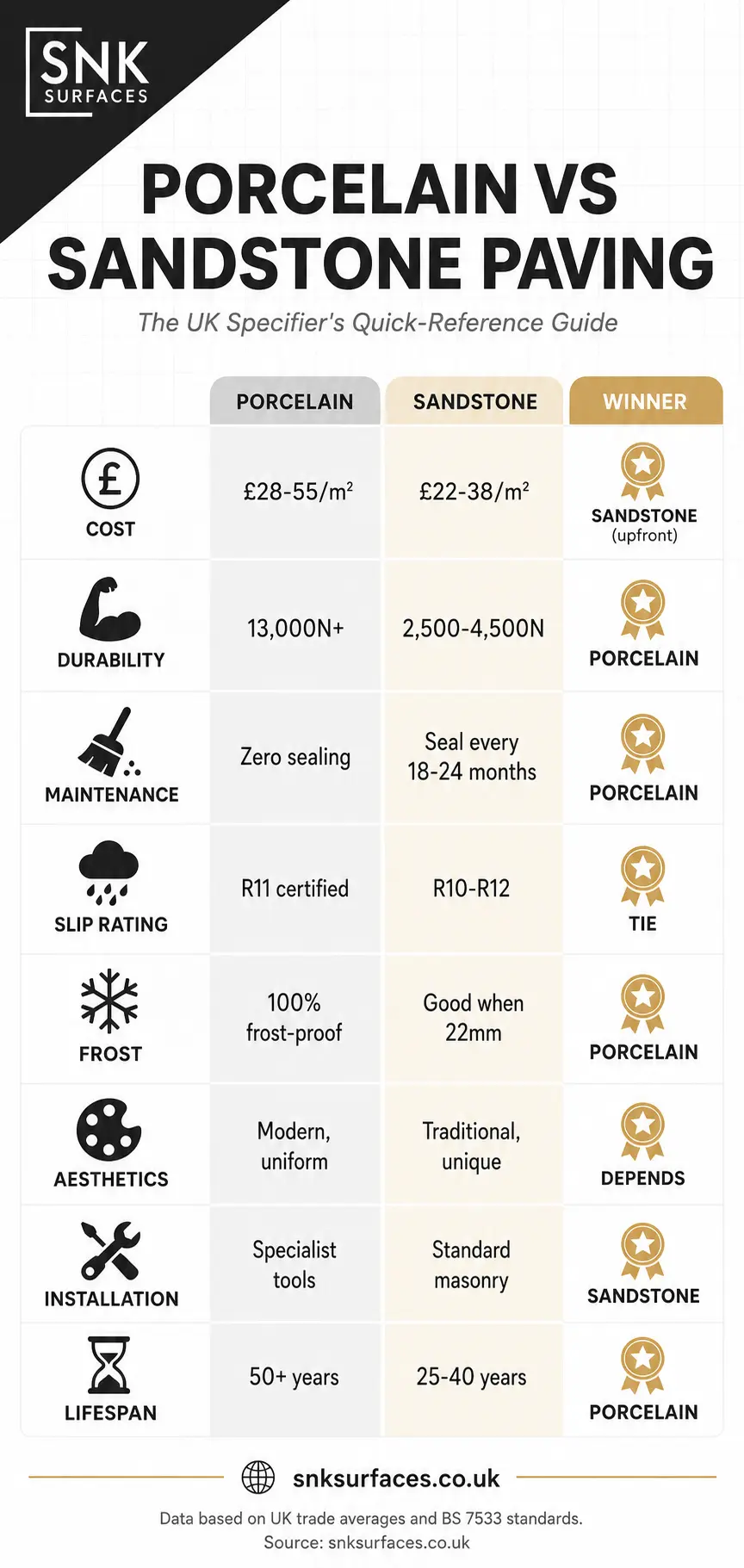
- Calibrated 22mm natural sandstone: £22–£38 per m²
- Premium 20mm outdoor porcelain: £28–£55 per m²
So sandstone wins on the initial invoice. But here is what most people forget:
Installation labour:
Porcelain is harder to install. It requires diamond tip wet blades to cut (standard stone blades will chip the edges), a polymer modified SBR slurry primer on the back of every single tile (because porcelain is non porous and will not bond to standard mortar), and tile levelling spacers to keep those tight 3mm joints flat. This adds roughly 15–25% more labour time compared to sandstone, which cuts easily and bonds naturally to a standard mortar bed.
10-year maintenance cost:
Sandstone requires chemical sealing every 18–24 months using an impregnating sealer like Lithofin MN Stain-Stop or Azpects Easy Seal. At roughly £4–£7 per m² per treatment, that adds up to £30–£60 per m² over ten years.
Porcelain requires zero sealant, zero chemical treatment, and zero re-sanding of joints over its entire lifespan. The maintenance cost is effectively £0.
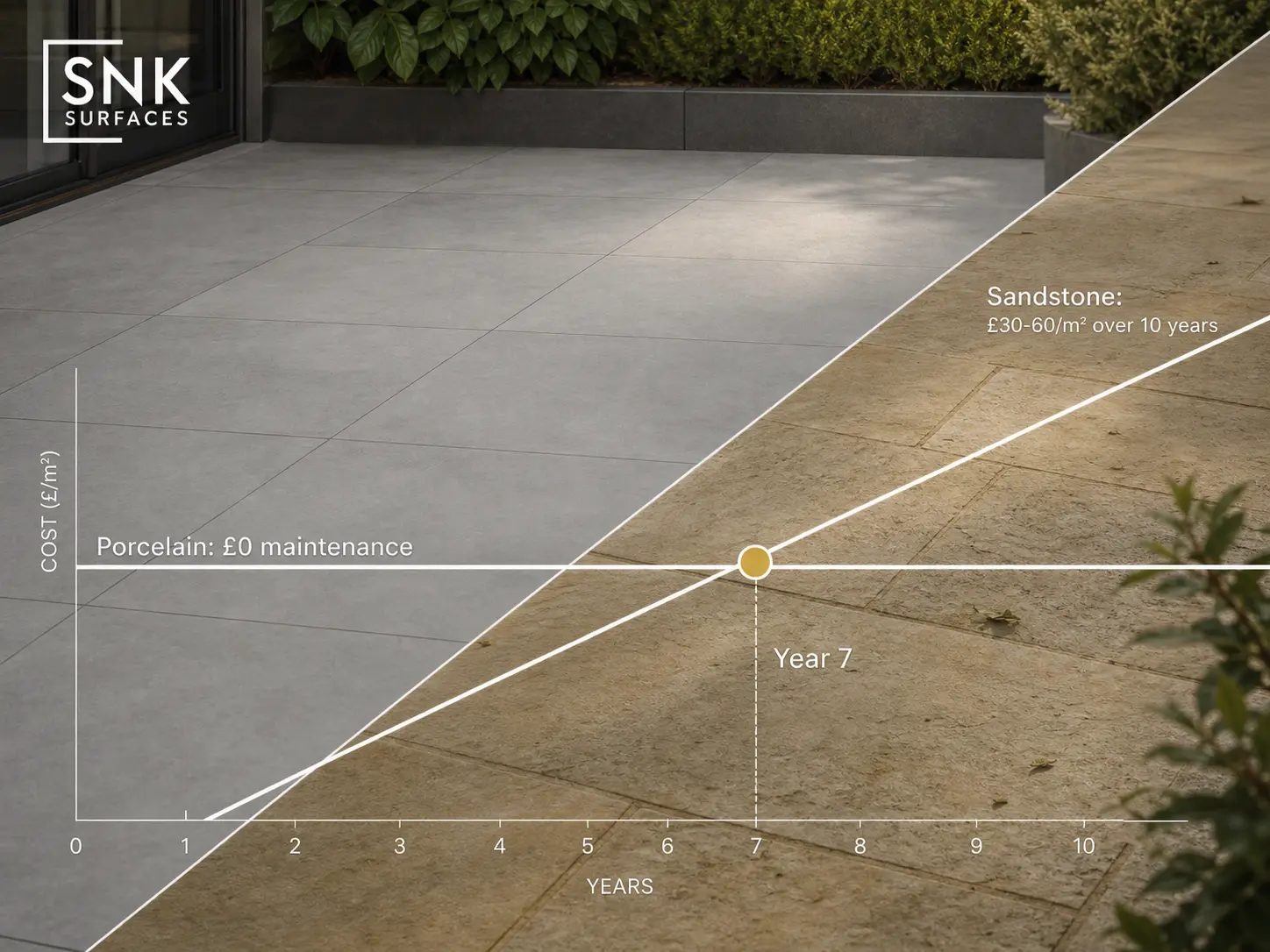
The honest verdict: Sandstone is cheaper on day one. Porcelain is cheaper by year seven. If your client plans to stay in the property long-term, porcelain is the better financial decision. If it is a quick flip or a tight-budget project, sandstone makes more sense upfront.
2. Durability: Which One Handles Real Life Better?
Patios take a beating. Garden furniture gets dragged across them. Heavy stone planters get dropped. Kids throw toys. Dogs dig at the edges. Which material survives?
Porcelain: The vitrification process (firing at 1,200°C+) creates a tile that is essentially glass-ceramic. It has a breaking strength of 13,000+ Newtons—roughly ten times the European minimum standard. It is scratch-resistant, chip resistant, and impervious to dropped BBQ tools or dragged metal furniture legs. You would struggle to damage a 20mm porcelain tile under normal garden use.
Sandstone: Natural sandstone is strong but softer. When calibrated to 22mm, it handles foot traffic and standard garden furniture without issue. But sharp metal chair legs, dragged planters, or heavy point loads can scratch or dent the surface over time. The good news is that the natural texture of riven sandstone tends to hide light scratches far better than the uniform surface of porcelain.
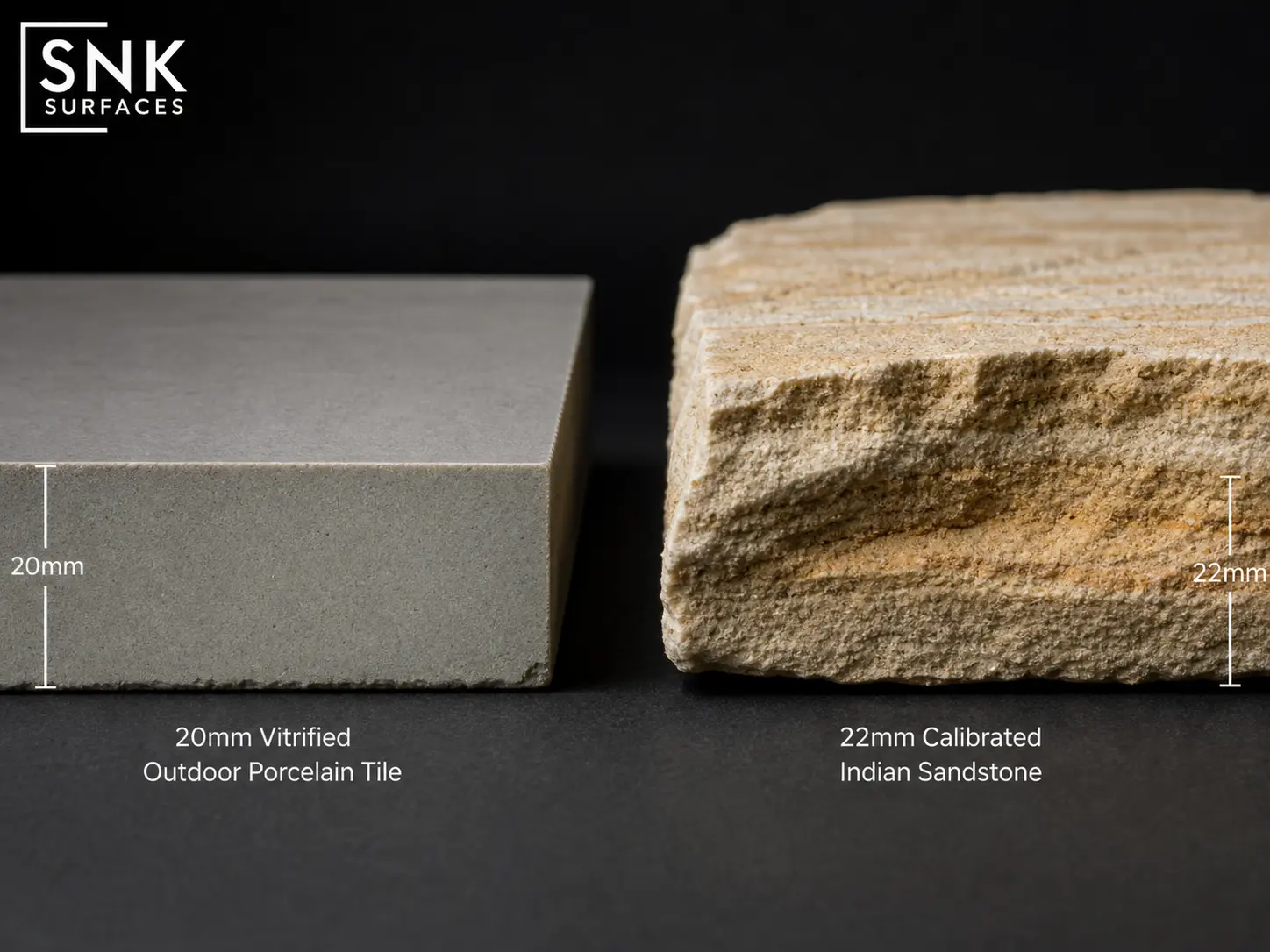
The honest verdict: Porcelain wins on pure structural strength. Sandstone wins on hiding everyday wear and tear.
3. Maintenance: The Porosity Problem
This is the single biggest practical difference between porcelain vs sandstone paving, and it is the reason most UK homeowners end up switching to porcelain after their first sandstone patio.
Porcelain (<0.5% water absorption):
The vitrified surface is so dense that liquids physically cannot penetrate it. Red wine, BBQ grease, coffee, motor oil, and leaf tannins all sit on the surface and wipe away with warm soapy water. Algae and lichen have no porous surface to root into, so the dreaded "black spot" infestation that plagues UK sandstone patios is physically impossible on porcelain.
Sandstone (1.5–5.0% water absorption):
Natural sandstone is a sponge at the microscopic level. If you spill red wine on unsealed sandstone, it soaks in within seconds and leaves a permanent stain. In damp, shaded UK gardens, algae spores colonise the pores and turn the stone green within a single winter. Black lichen spots (lichen acidophilus) root deep into the capillaries and are extremely difficult to remove without chemical treatment.
What this means in practice:
- A porcelain patio needs a quick jet wash once a year. That is it.
- A sandstone patio needs sweeping weekly (wet leaves cause tannin stains), pressure washing monthly, and chemical sealing every 18–24 months.
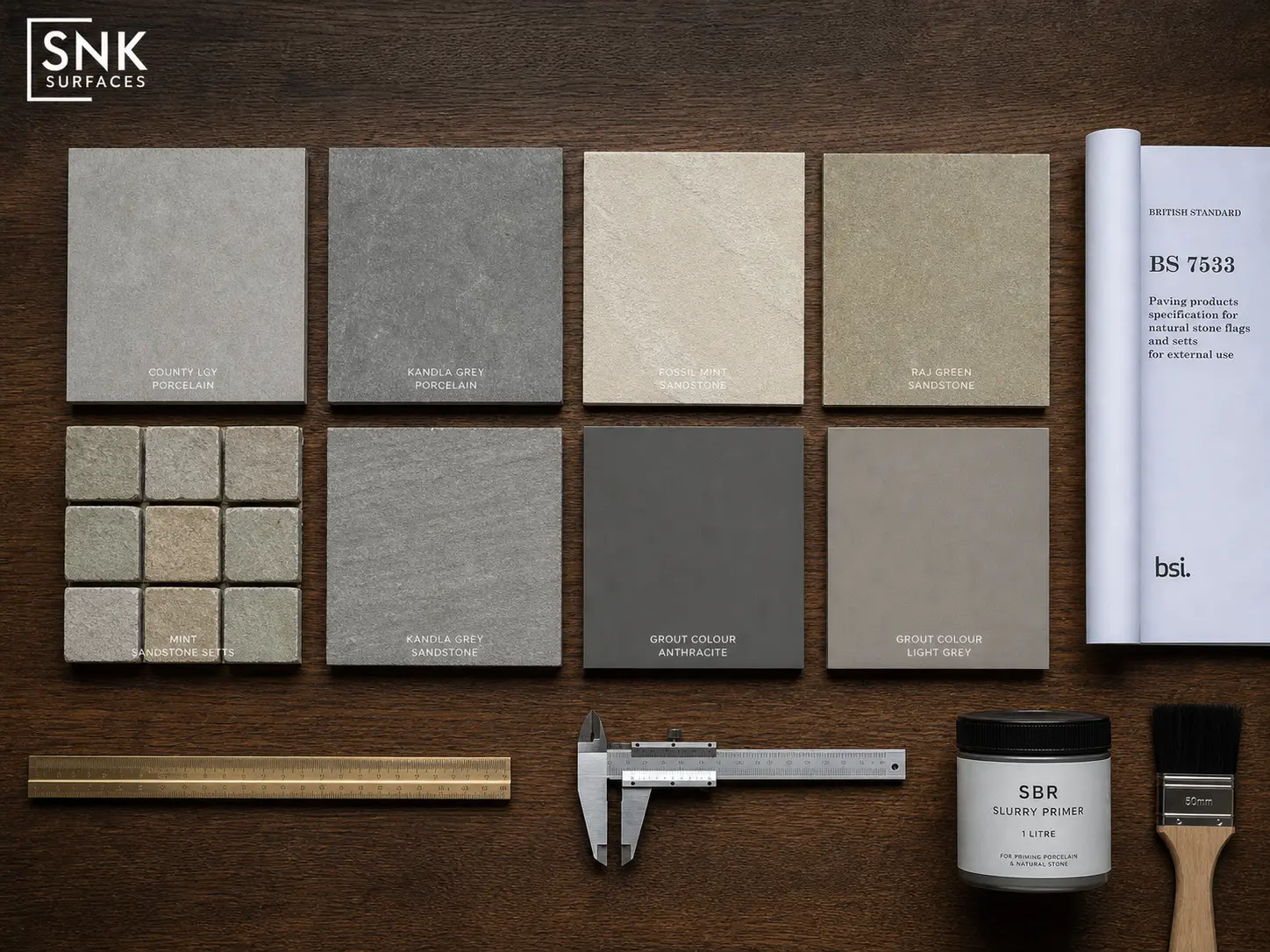
If your client says "I don't want to spend my weekends cleaning the patio," specify porcelain. It is that simple. Our County LGY Porcelain Paving and Kandla Grey Porcelain ranges are the most popular choices for zero-maintenance UK gardens.
4. Slip Resistance: Safety in the Rain
The UK gets an average of 133 rainy days per year. Slip resistance is not optional it is a legal requirement for commercial projects under HSE slip resistance guidelines and a moral one for family gardens.
Porcelain: Quality outdoor porcelain tiles carry a certified R11 slip rating (DIN 51130) and a PTV of 36+ in wet conditions (BS 7976-2 pendulum test). The micro-texture is mechanically pressed into the surface during manufacturing, so it is uniform and predictable across every single tile. You know exactly what grip you are getting.
Sandstone: Natural riven sandstone provides excellent wet grip thanks to its undulating, cleft surface ridges. It typically achieves R10 - R12 depending on the specific finish. However, sawn and honed sandstone can become slippery when wet unless it has been mechanically textured. And here is the critical point: if you allow algae to colonise unsealed sandstone over winter, the biofilm creates a severe slip hazard regardless of the stone's original rating.
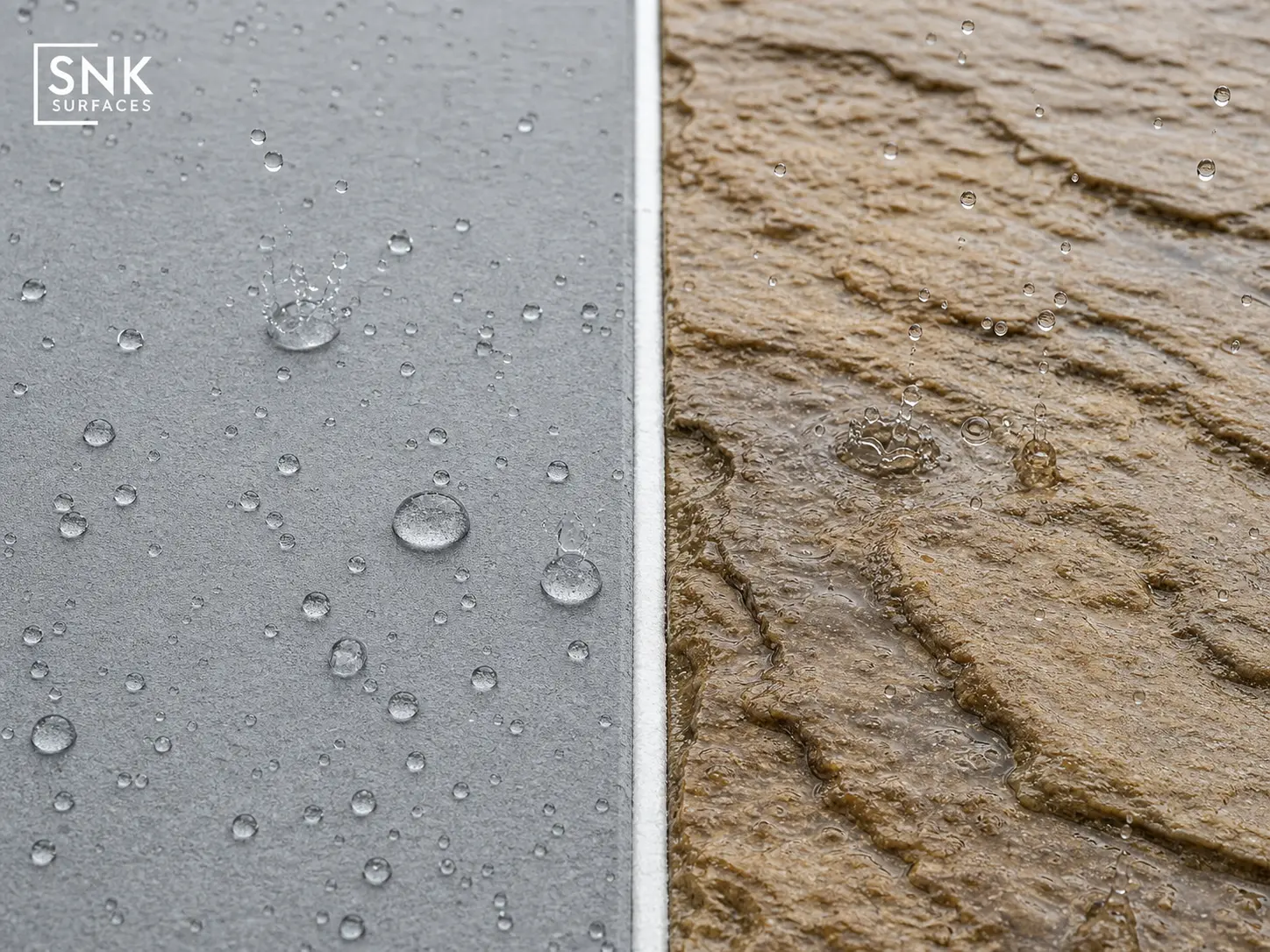
The honest verdict: Both materials can achieve safe slip ratings when new. But porcelain maintains its rating consistently over decades, while sandstone's grip degrades if maintenance is neglected.
5. Frost Resistance: Surviving British Winters
Water expands by 9% when it freezes. This is the number one cause of paving failure in the UK.
Porcelain: With a water absorption rate of less than 0.5%, moisture simply cannot enter the tile body. There is no water inside to freeze, expand, and crack the material. Vitrified porcelain is 100% frost proof. It will not spall, flake, or delaminate after decades of British freeze-thaw cycles.
Sandstone: When porous sandstone absorbs winter rainwater and the temperature drops below zero, the trapped water freezes and expands, creating internal hydraulic pressure. In high-quality, calibrated 22mm sandstone like our Kandla Grey Sandstone, this is rarely a problem because the stone is dense enough to resist the pressure. But in cheaper, uncalibrated 15–18mm sandstone with prominent bedding planes, repeated freeze thaw cycles will cause the top layers to spall and flake within a few winters.
The rule of thumb: If you choose sandstone, always specify calibrated 20–22mm thickness from a reputable supplier. Never buy thin, uncalibrated stone for UK outdoor use. Read our Indian Sandstone Buyer's Guide for the full breakdown on what to look for.
6. Aesthetics: Modern vs Traditional
This is the most subjective factor, but it is also the one that makes or breaks a garden design.
Porcelain: Clean, crisp, and contemporary. Precision rectified edges allow ultra tight 3–4mm grout joints, creating a seamless, monolithic surface that looks like a single continuous plane. The colour is digitally controlled during manufacturing, so every tile is identical. This makes porcelain the obvious choice for modern architecture, flush bi fold door thresholds, and minimalist garden designs.
Our most popular porcelain ranges:
- County LGY Porcelain A warm light-grey "greige" tone that avoids the sterile, concrete-like look of cheaper porcelain.
- Kandla Grey Porcelain Replicates the silvery-grey tones of natural Kandla sandstone with absolute colour consistency.
Sandstone: Warm, organic, and full of character. Every slab is unique, with natural veining, mineral deposits, and tonal variations that tell a geological story. Hand-dressed edges and wider 10–15mm mortar joints give sandstone a traditional, handcrafted feel that suits period homes, cottages, and heritage properties.
Our most popular sandstone ranges:
- Fossil Mint Sandstone Pale cream, ivory, and soft sage green with stunning natural dendrite markings.
- Kandla Grey Sandstone Cool silver grey with subtle blue and purple undertones.
- Raj Green Sandstone Earthy olive green, brown, and grey tones that mimic native Yorkstone.
The honest verdict: Neither is "better." Porcelain suits modern homes. Sandstone suits traditional homes. The mistake is choosing the wrong material for the wrong architectural context.
7. Installation: What Your Contractor Needs to Know
Both materials require a solid sub-base that meets BS 7533 paving standards. But the installation processes differ significantly, and getting them wrong is the most common cause of patio failure in the UK.
Porcelain installation (less forgiving):
- Compact 100–150mm MOT Type 1 sub-base.
- Lay a full 30–40mm wet mortar bed (4:1 sharp sand and cement). No dot and dab porcelain requires 100% contact with the mortar.
- Paint the back of every tile with a polymer modified SBR slurry primer (e.g., Larsen LPA or Mapei Kerabond). This is non negotiable. Porcelain is non-porous and will not bond to standard cement without it. Skip this step and your tiles will de bond within 6–12 months.
- Cut with a continuous-rim diamond blade on a wet saw. Standard stone blades will chip the edges.
- Use tile levelling spacers for the 3–4mm joints.
- Grout with an exterior grade epoxy or resin based porcelain grout.
Sandstone installation (more forgiving):
- Compact 100–150mm MOT Type 1 sub-base.
- Lay a full wet mortar bed (4:1 sharp sand and cement).
- Apply SBR slurry primer to the back of each slab (strongly recommended to prevent efflorescence, especially on light stones like Mint Sandstone).
- Cut with a standard masonry blade sandstone is much softer and easier to cut than porcelain.
- Point with a 10–15mm sand and cement or brush in resin jointing compound.
The honest verdict: Sandstone is faster and easier to lay, which means lower labour costs. Porcelain demands more skill and specialist tools, which adds 15–25% to the installation bill. If your contractor is not experienced with porcelain, have a conversation before specifying it.
8. Lifespan: How Will It Look in 20 Years?
Porcelain: Effectively permanent. Vitrified ceramic does not fade in UV light, does not react to acidic bird droppings or tree sap, and does not weather down. A porcelain patio will look identical in year 20 to the day it was laid. Expected lifespan: 50+ years.
Sandstone: Ages naturally and develops a patina over time. In traditional garden settings, this gradual softening of edges and subtle colour mellowing is part of the charm. Properly maintained, high-density calibrated Indian sandstone will last 25–40 years without structural issues.
| Factor | 20mm Outdoor Porcelain | 22mm Calibrated Sandstone | Standard / Test |
|---|---|---|---|
| Material | Vitrified clay, quartz, feldspar | Natural sedimentary sandstone | BS EN 14411 |
| Water Absorption | <0.5% (non-porous) | 1.5–5.0% (porous) | BS EN ISO 10545-3 |
| Slip Rating (Wet) | R11 certified / PTV 36+ | R10–R12 (varies by finish) | BS 7976-2 |
| Breaking Strength | 13,000N+ | 2,500–4,500N | BS EN 1339 |
| Frost Resistance | 100% frost-proof | Good when calibrated to 22mm | BS EN 12371 |
| Stain Resistance | Class 5 (maximum) | Moderate (needs sealing) | BS EN ISO 10545-14 |
| Grout Joint Width | 3–5mm | 10–15mm | BS 7533 |
| Slurry Primer | Mandatory | Recommended | BS 7533-102 |
| Upfront Cost (m²) | £28–£55 | £22–£38 | UK trade average |
| 10-Year Maintenance | £0 | £30–£60 | Lifecycle model |
| Lifespan | 50+ years | 25–40 years | Industry estimate |
| Best For | Modern homes, bi folds, roof terraces | Cottages, heritage, traditional gardens | Design context |
When to Choose Porcelain
Specify 20mm outdoor porcelain when:
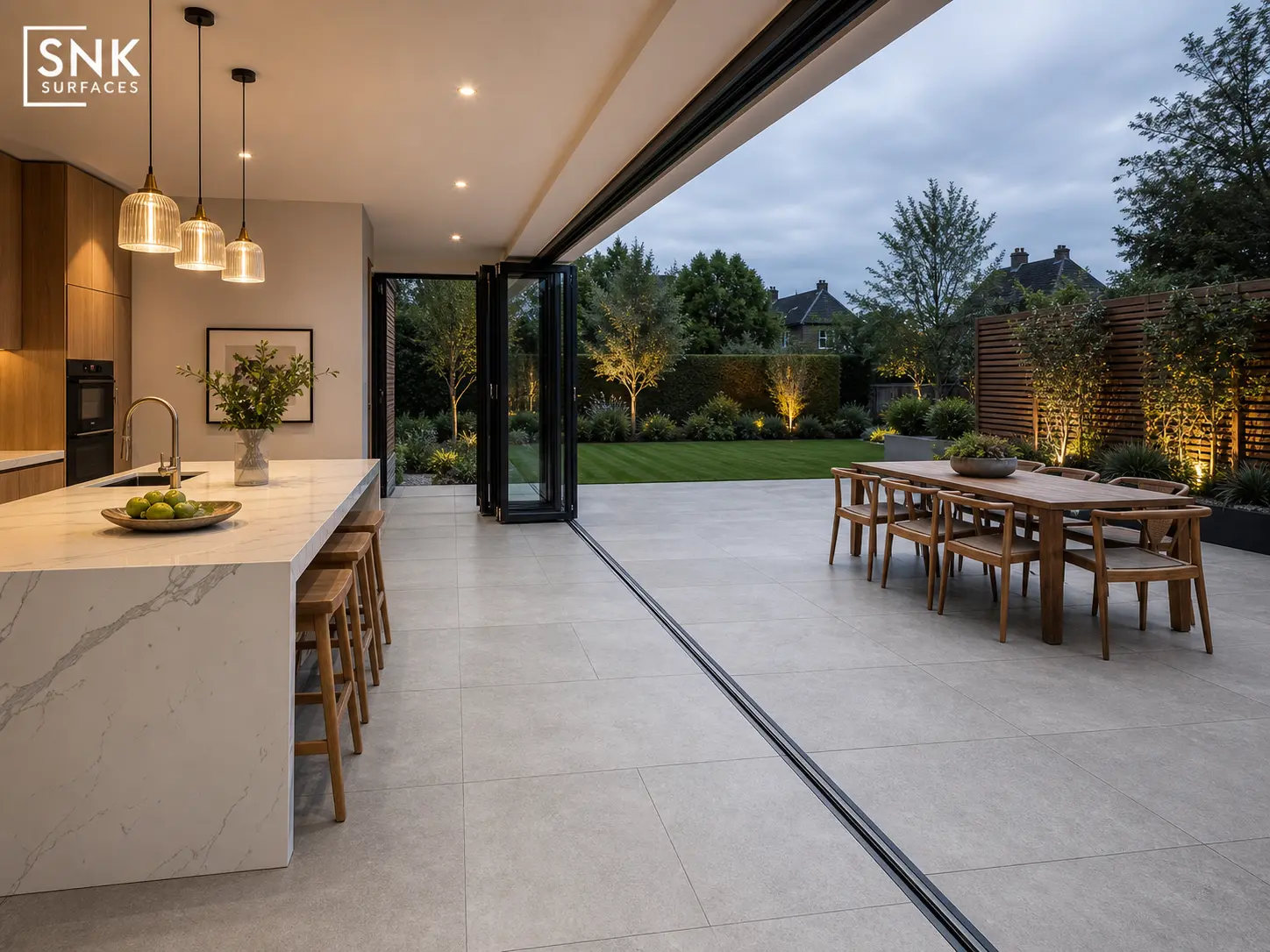
- The brief calls for a modern, seamless look. Flush bi fold door thresholds, clean horizontal lines, and tight 3mm joints are porcelain's strengths.
- The client wants zero maintenance. No sealing, no chemical cleaning, no black spot lichen. Ever.
- You are building a roof terrace or balcony. Porcelain can be laid on adjustable pedestals without a heavy mortar bed, reducing weight on the structure.
- Colour consistency is critical. Every tile is identical, which matters on large commercial projects where batch variation is unacceptable.
When to Choose Sandstone
Specify 22mm calibrated natural sandstone when:
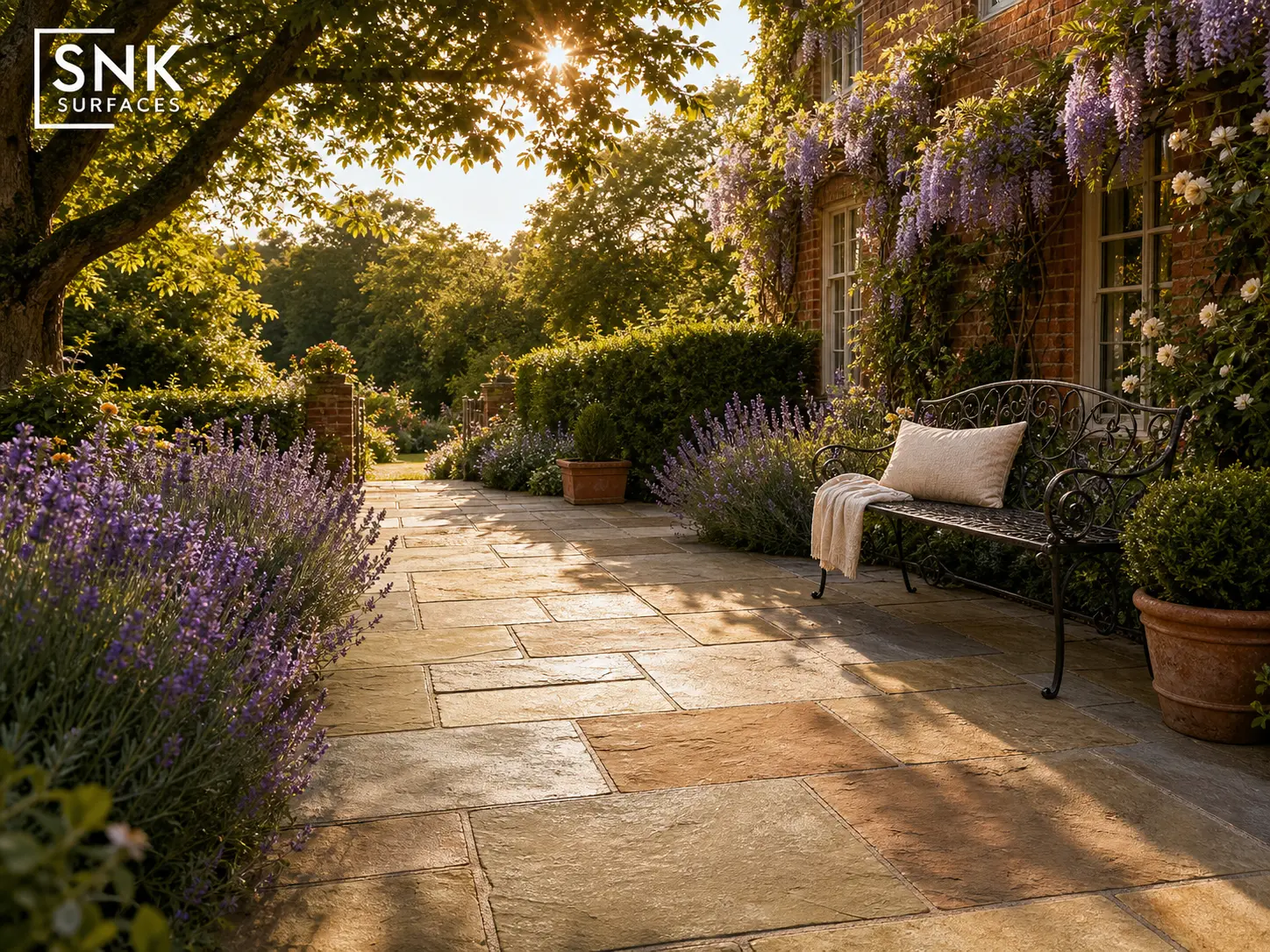
- The property has heritage character. Porcelain looks out of place next to Cotswold stone, Georgian brickwork, or Victorian ironwork. Sandstone blends naturally.
- The client loves organic character. No two slabs are the same. The natural veining, fossil markings, and tonal variations give each patio a unique identity.
- Budget is tight. The lower upfront cost of sandstone makes a real difference on large projects.
- Your contractor is a traditional landscaper. Sandstone is more forgiving to lay and does not require specialist diamond blades or porcelain-specific primers.
Can You Mix Porcelain and Sandstone in One Garden?
Yes and this is the approach we recommend most often to UK landscape architects.
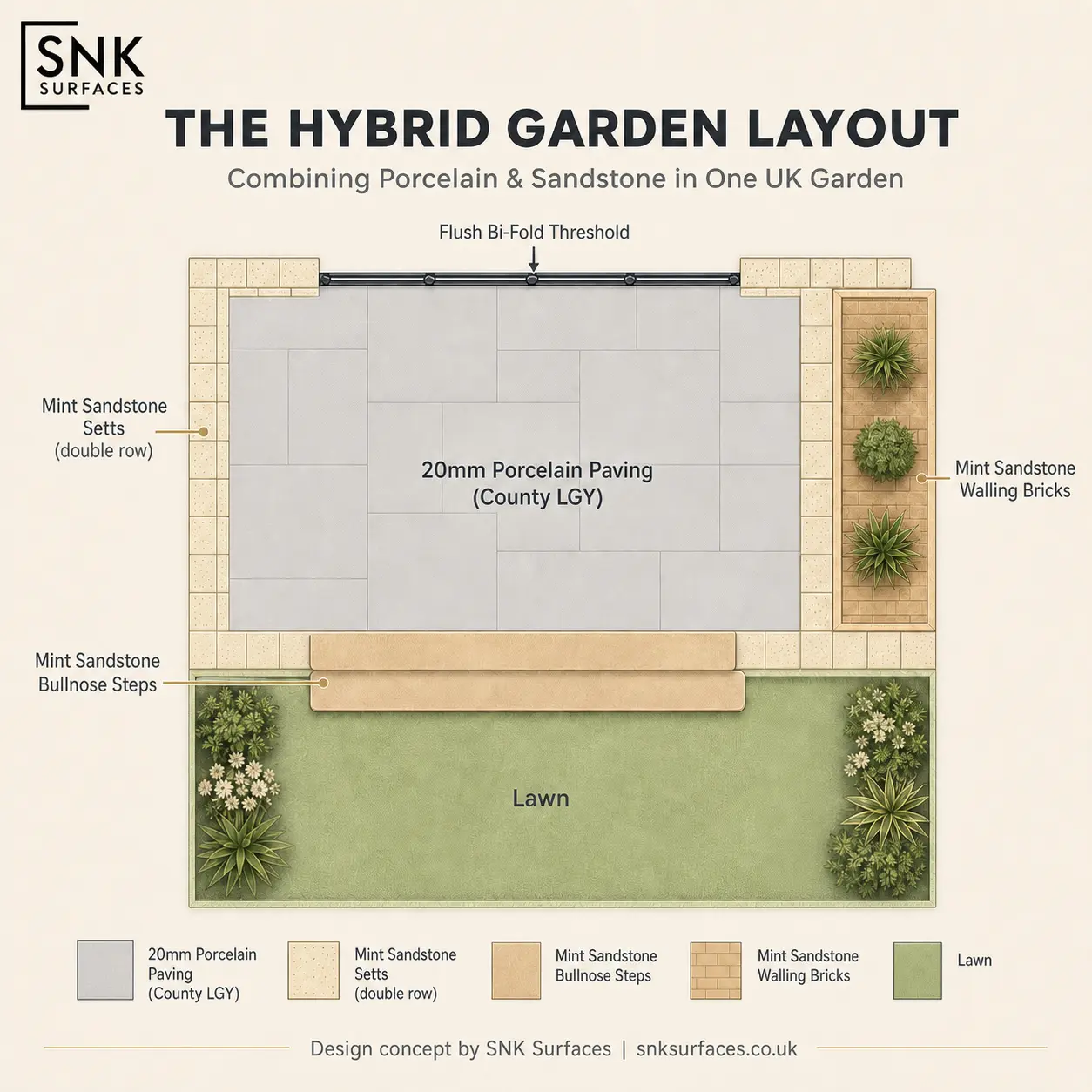
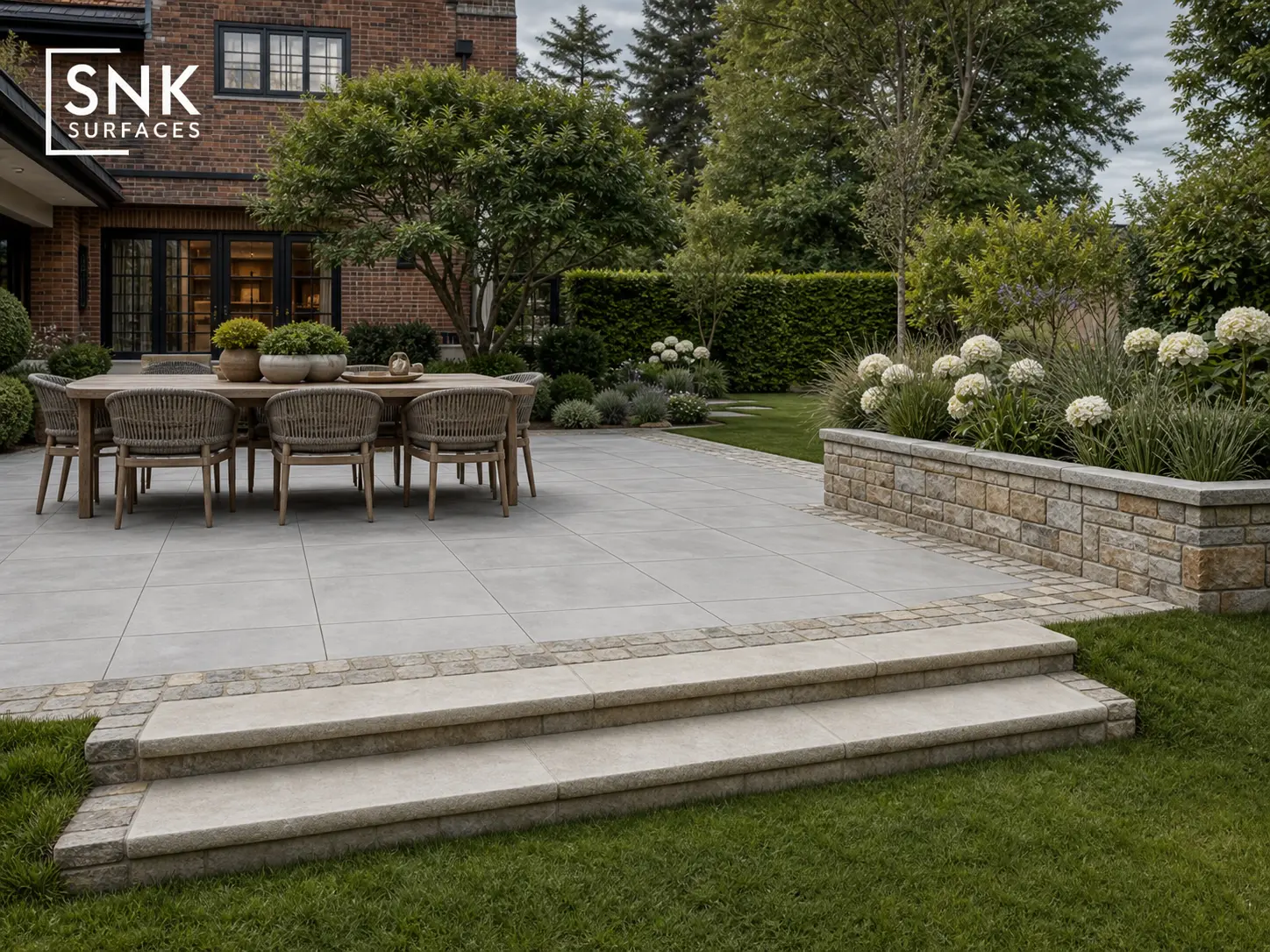
By combining both materials, you get the practical benefits of porcelain in high use areas and the natural beauty of sandstone in the surrounding garden. Here are three proven combinations:
- 1. Porcelain patio with sandstone borders: Lay the main dining terrace in large format County LGY Porcelain for a wipe-clean, stain-proof surface. Frame the entire terrace with a double row of tumbled Mint Sandstone Setts or Mint Sandstone Cobbles. The textured stone border softens the clean lines of the porcelain and ties the patio into the surrounding lawn and planting.
- 2. Porcelain terrace with sandstone steps: When stepping down from a modern upper terrace to a lower lawn, use solid Mint Sandstone Bullnose Steps. The organic stone provides superior grip underfoot and creates a natural transition from the contemporary paving to the soft garden.
- 3. Porcelain floor with sandstone walls: Carry horizontal porcelain paving up to raised planter beds constructed from Mint Sandstone Walling Bricks. The contrast between the sleek floor and the rustic vertical stone creates rich architectural depth.
Frequently Asked Questions
1. Does outdoor porcelain crack in UK winters?
No. Vitrified porcelain absorbs less than 0.5% water, making it completely immune to freeze-thaw damage. As long as it is installed on a full mortar bed with a solid sub-base, it will not crack under freezing conditions.
2. Can you pressure wash both materials?
Yes. Porcelain can handle high-pressure washing without damage. Sandstone should be washed on a lower pressure fan setting held at least 30cm from the surface to avoid damaging the stone or dislodging the pointing.
3. Which gets hotter in summer sun?
Dark shades of both materials absorb heat. Dark porcelain retains heat slightly longer than sandstone due to its thermal mass. For barefoot comfort around pools, choose light tones like County LGY porcelain or Fossil Mint Sandstone.
4. Should I seal outdoor porcelain?
No. Never apply sealant to vitrified porcelain. The sealant cannot penetrate the non-porous surface and will dry into a cloudy film that ruins the anti slip texture.
5. Why does sandstone turn green?
Because sandstone is porous, it absorbs rainwater and airborne algae spores. In damp, shaded UK gardens, this leads to green algae growth and black lichen spots. Regular sealing with an impregnating sealer prevents this.
6. Can I drive on 20mm porcelain tiles?
Only if laid on a reinforced concrete base with full-contact flexible adhesive. Never lay porcelain on a flexible sand base for vehicular traffic. For driveways, thick Mint Sandstone Setts on a mortar bed are the better choice.
7. Why is porcelain installation more expensive?
Porcelain requires diamond tip wet blades, mandatory SBR slurry primer on every tile, and levelling spacers for 3mm joints. This precision work takes longer and requires specialist tools.
8. Is riven sandstone anti-slip?
Yes. The natural cleft texture provides excellent grip underfoot, easily meeting UK wet slip safety standards.
9. Which is more environmentally sustainable?
Sandstone has lower manufacturing energy (quarried and cut, not fired at 1,200°C). Porcelain has higher manufacturing carbon but a longer lifespan and zero chemical maintenance. Over a 50-year lifecycle, both are broadly comparable.
10. What is the minimum joint width?
Porcelain: 3–5mm with exterior resin grout. Sandstone: 10–15mm with traditional pointing or brush-in compound.
The Bottom Line
There is no single "best" paving material. There is only the right material for your specific project, your client's lifestyle, and your budget.
Choose porcelain if the brief demands clean modern lines, zero maintenance, and a patio that will look flawless for decades without lifting a finger.
Choose sandstone if the property has traditional character, the client loves natural variation, and the budget needs to stretch across a large area.
Choose both if you want the practical benefits of porcelain underfoot and the timeless beauty of natural stone in the borders, steps, and walls.
Whatever you decide, make sure you are buying from a supplier who controls the entire supply chain. At SNK Surfaces, we manufacture both our porcelain and our sandstone ranges in-house, which means guaranteed batch consistency, calibrated thickness, and direct from source trade pricing whether you are ordering 10m² for a back garden or 500m² for a commercial development.
Want to compare the materials in person?
Request a free sample box with cut-offs from our porcelain and sandstone ranges, delivered direct to your UK site or office.
Browse the full collection