
UK & Ireland Paving Comparison Guide
Porcelain vs Concrete Pavers: Which Is Best for UK & Irish Patios?
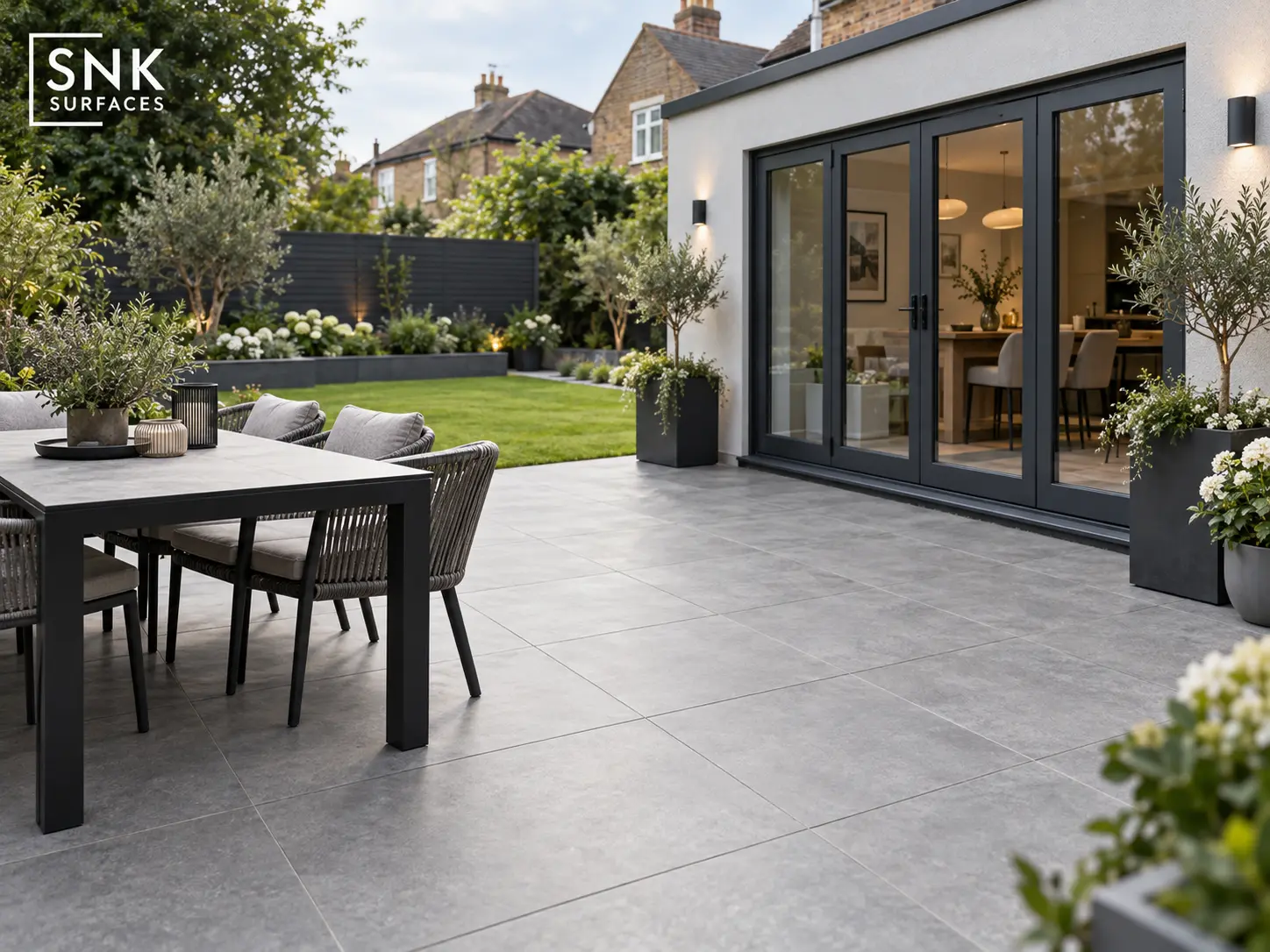
The Merchant Yard Dilemma
Every spring, thousands of homeowners and landscapers across Britain and Ireland face the same choice: porcelain vs concrete pavers.
Budget concrete flags look like an easy bargain on paper. At £18 to £28 per square metre, they seem to save plenty of money upfront. For anyone watching a tight renovation budget, choosing concrete feels tempting.
However, day-one material prices do not tell the whole story. The damp, cold climate across the UK and Ireland is tough on porous materials. After two or three damp winters, cheap concrete flags often fade, turn green with algae, and start crumbling at the edges.
This practical guide compares porcelain vs concrete pavers with honest facts and real site numbers. We look at manufacturing, five-year weathering, installation standards, and the true cost of owning a 50m² patio.
How Both Materials Are Made
To understand why porcelain vs concrete pavers perform differently, you have to look at how each slab is manufactured.
Cast Concrete Pavers
Decorative concrete flags are made by mixing Portland cement, sand, gravel, water, and artificial dyes. Factories pour this mix into moulds or press it under hydraulic rams before letting it cure at room temperature.
Because water is used to hydrate the cement, tiny pores and capillary channels remain inside the concrete once dry. These pores make the slab porous. In addition, the colour is only an artificial dye mixed into the paste. Rain and sunlight break down these surface dyes over time.
20mm Vitrified Porcelain Slabs
Outdoor porcelain is made using an entirely different process. Refined white clay, quartz, and feldspar minerals are compressed under thousands of tonnes of pressure. The slabs then travel through a kiln fired at 1,200 degrees Celsius.
This extreme heat melts the minerals together into a solid, glass-like body. The finished slab has virtually no internal air pockets. The colours are natural mineral pigments baked directly into the tile body. When testing porcelain vs concrete pavers for durability, this kiln-fired density gives porcelain an obvious advantage.
The 5-Year Weathering Reality in Damp Climates
A patio in Coventry, Dublin, Belfast, or Manchester spends months sitting in rain and freezing weather. Evaluating porcelain vs concrete pavers after five years of real weather reveals a massive performance difference.
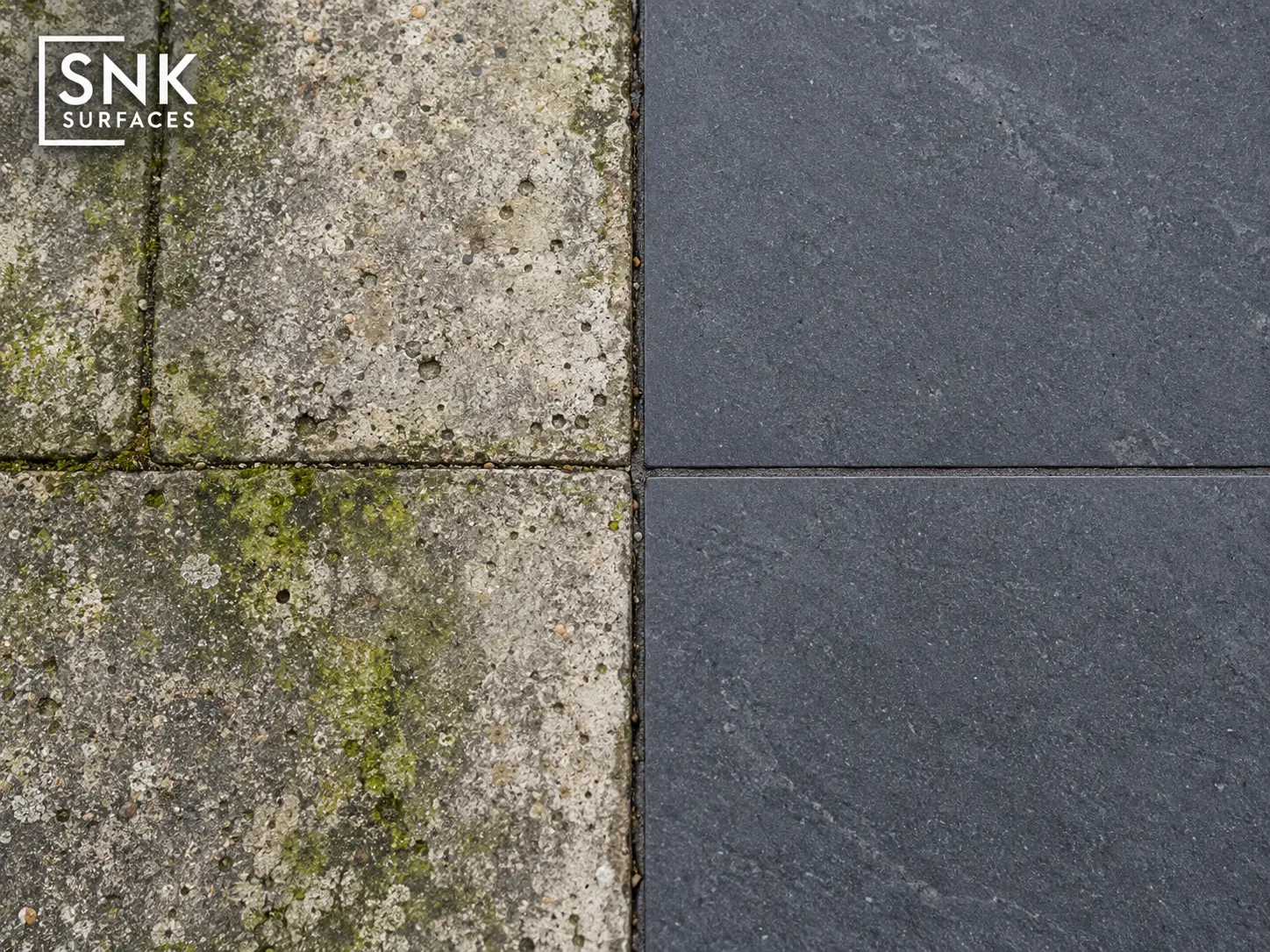
Water Absorption: 6% to 8% vs Under 0.05%
Standard cast concrete paving absorbs between 6% and 8% of its own weight in water. Every heavy downpour turns the slab into a damp sponge.
Vitrified porcelain tested under BSI Group standards absorbs less than 0.05% water. Rainwater stays on top of the slab and runs harmlessly toward your drainage points. In this test of porcelain vs concrete pavers, porcelain stops water penetration completely.
Frost Damage and Surface Pitting
High water absorption leads directly to winter frost damage. When concrete soaks up autumn rain and temperatures plunge below zero, that trapped water freezes into ice. Ice expands by about 9%, putting heavy pressure on the cement matrix.
Over repeated freeze-thaw cycles, this internal pressure causes concrete flags to pit, flake, and break away at the corners. Because vitrified porcelain holds virtually no internal water, frost cannot harm it. For exposed northern sites, porcelain vs concrete pavers is an easy call for frost defence.
Sun Exposure and Colour Fading
Homeowners often buy dark grey concrete flags wanting a contemporary finish. Unfortunately, sunlight and acidic rainwater break down the artificial dyes. Within three summers, dark charcoal concrete flags fade into a patchy, chalky light grey.
Because the mineral colours in porcelain are baked at high kiln heat, they never fade. A dark charcoal slab like our County Anthracite porcelain stays the exact same colour in year ten as it was on day one.
Efflorescence and Salt Staining
If you have ever seen an unsightly white powder appear on a concrete patio after rain, you have seen efflorescence. It is a common frustration with concrete flags.
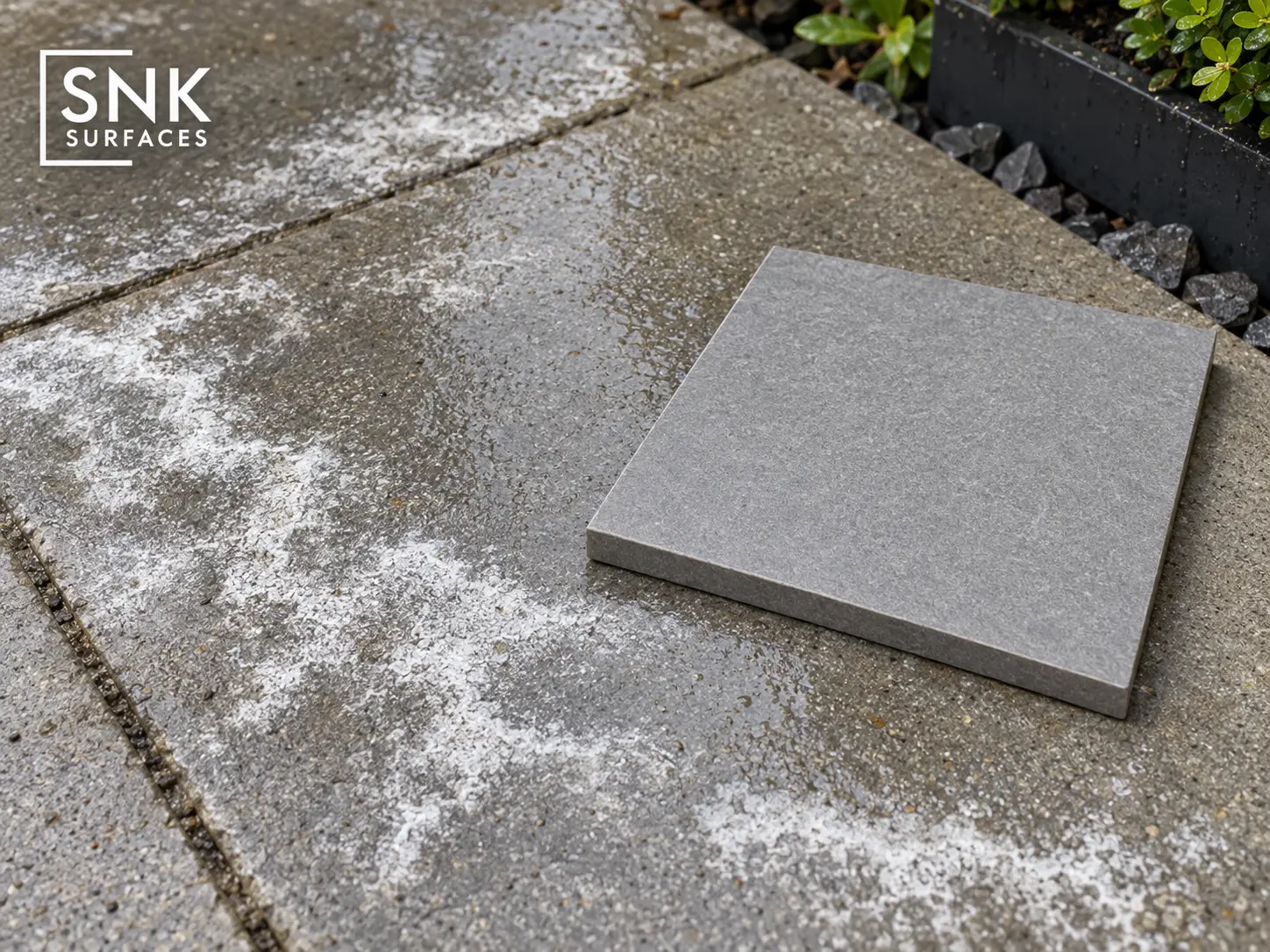
Concrete contains Portland cement, which holds natural calcium salts. When rainwater enters the slab, it dissolves those salts. As the sun warms the patio, water evaporates upward, dragging the dissolved salts to the surface. When the moisture hits the air, it hardens into a tough white crust.
Suppliers often claim efflorescence washes away naturally. In reality, concrete can keep pushing white salts to the surface for years.
In the comparison of porcelain vs concrete pavers, vitrified porcelain completely prevents efflorescence. Because porcelain contains no Portland cement and absorbs almost zero moisture, internal salts simply do not exist inside the slab.
Slip Resistance Comparison in Wet Weather
Safety underfoot matters for families, pets, and commercial paths. When comparing porcelain vs concrete pavers for slip safety, how the surface ages makes all the difference.
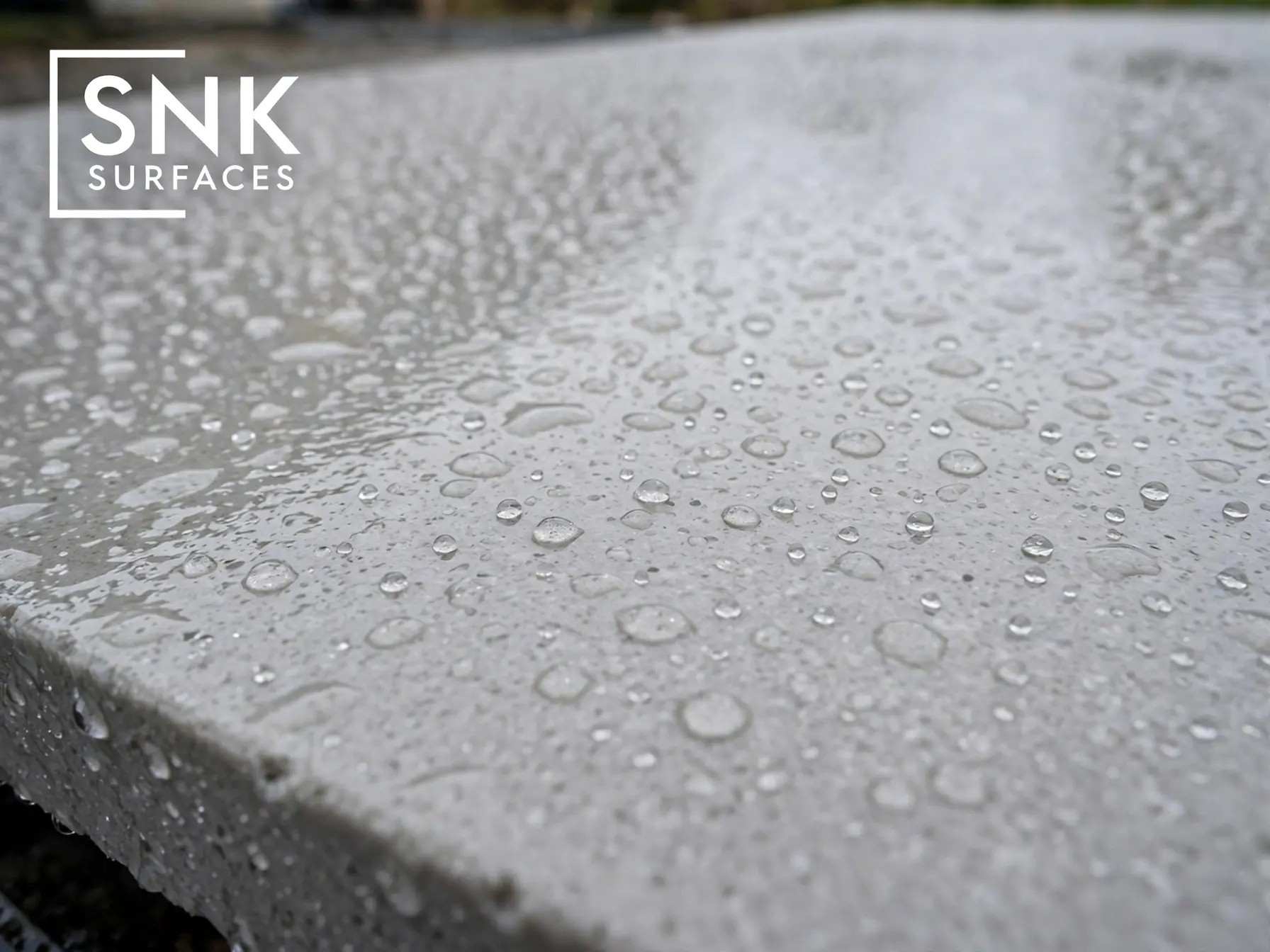
New pressed concrete flags feel grippy at first due to their coarse cement texture. However, because concrete is porous, damp garden patios quickly collect green algae and moss inside the surface pores. Once wet algae coats the slab, concrete turns dangerously slick.
Quality 20mm outdoor porcelain features an engineered micro-textured surface. It achieves an R11 slip rating under the German DIN standards ramp test.
Even more importantly for UK and Irish sites, R11 porcelain achieves a wet Pendulum Test Value of 36 or higher, meeting HSE slip safety guidelines for low slip potential in wet conditions. Because green algae cannot root into vitrified porcelain, the wet grip of porcelain vs concrete pavers stays dependable all year round.
Groundwork and Installation Differences
For landscaping contractors and builders, the biggest practical difference in porcelain vs concrete pavers happens during ground preparation. You cannot lay both materials the same way.
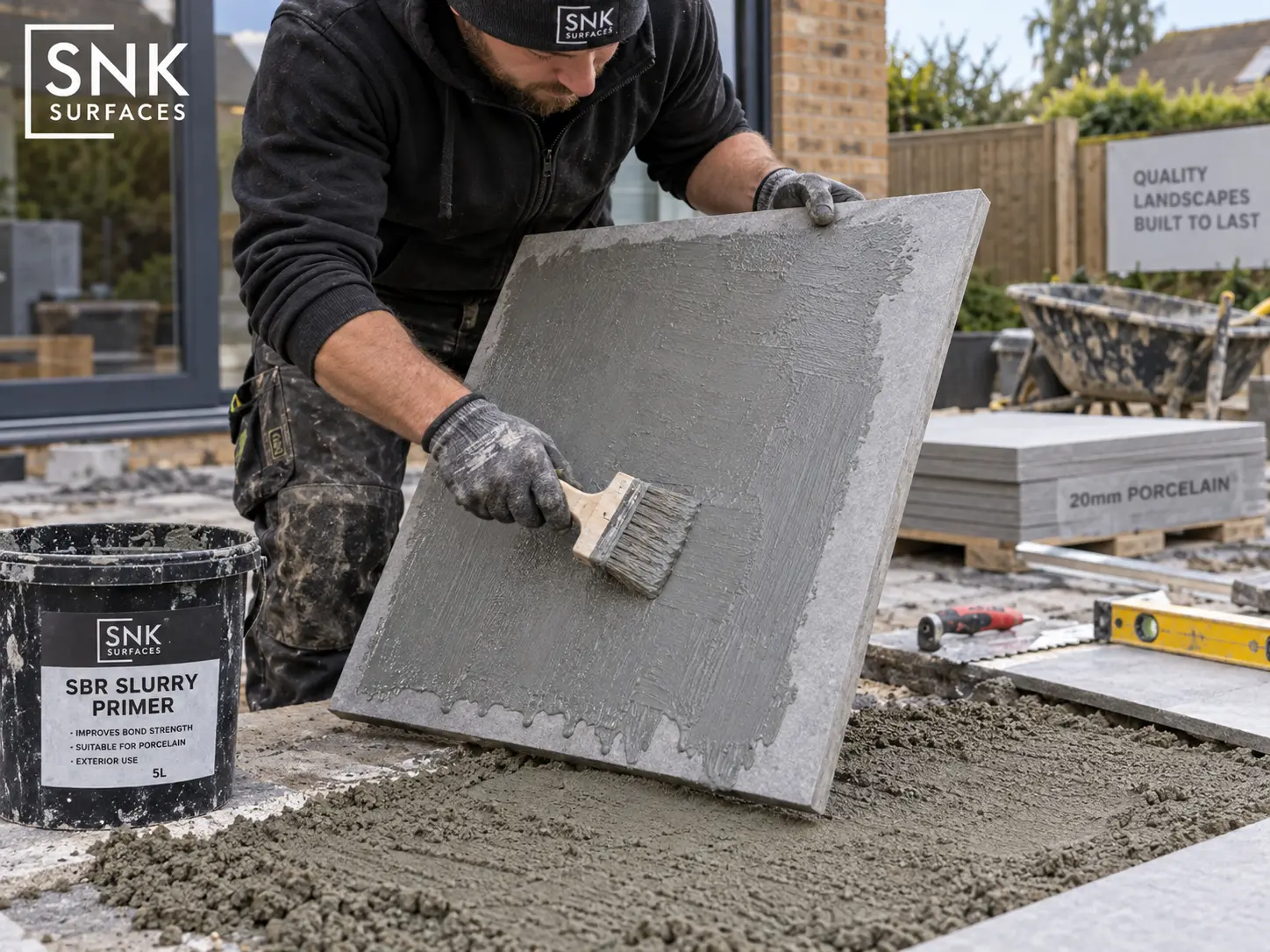
Laying Concrete Pavers
Thick concrete flags are often laid on a flexible bed of compacted sand, or on a 5:1 sand and cement bed. Because concrete is porous, wet mortar bonds naturally to the underside without specialist primers. However, flexible sand beds often lead to weed growth, ant nests, and sinking over clay ground.
Laying 20mm Porcelain (BS 7533 Standards)
Vitrified porcelain must always be installed rigidly to meet BS 7533 trade standards:
- Sub-Base: Dig out 150mm and compact 100mm of MOT Type 1 aggregate. Maintain a minimum 1:60 drainage fall.
- Full Wet Mortar Bed: Lay every slab onto a continuous 30mm to 50mm wet bed of 4:1 sharp sand and cement. Never use spot bedding. Leaving hollow gaps under porcelain causes cracked slabs. Read our full report on why paving slabs crack.
- Mandatory SBR Slurry Primer: Because porcelain absorbs zero water, mortar cannot grip the smooth back of the tile. Coat the underside of every slab with a polymer-modified SBR slurry primer before laying.
- Narrow Joints: Use spacers to keep tight 3mm to 5mm joints filled with exterior porcelain grout.
While rigid laying takes more care on site, evaluating porcelain vs concrete pavers for durability shows that a BS 7533 porcelain installation prevents callbacks entirely. If your patio connects to wide patio doors, check our advice on outdoor porcelain for bi-fold doors.
Complete 5-Year Cost Breakdown (50m² UK & Ireland Patio Model)
Here is a realistic five-year cost comparison for a standard 50m² garden patio using typical trade and domestic averages.
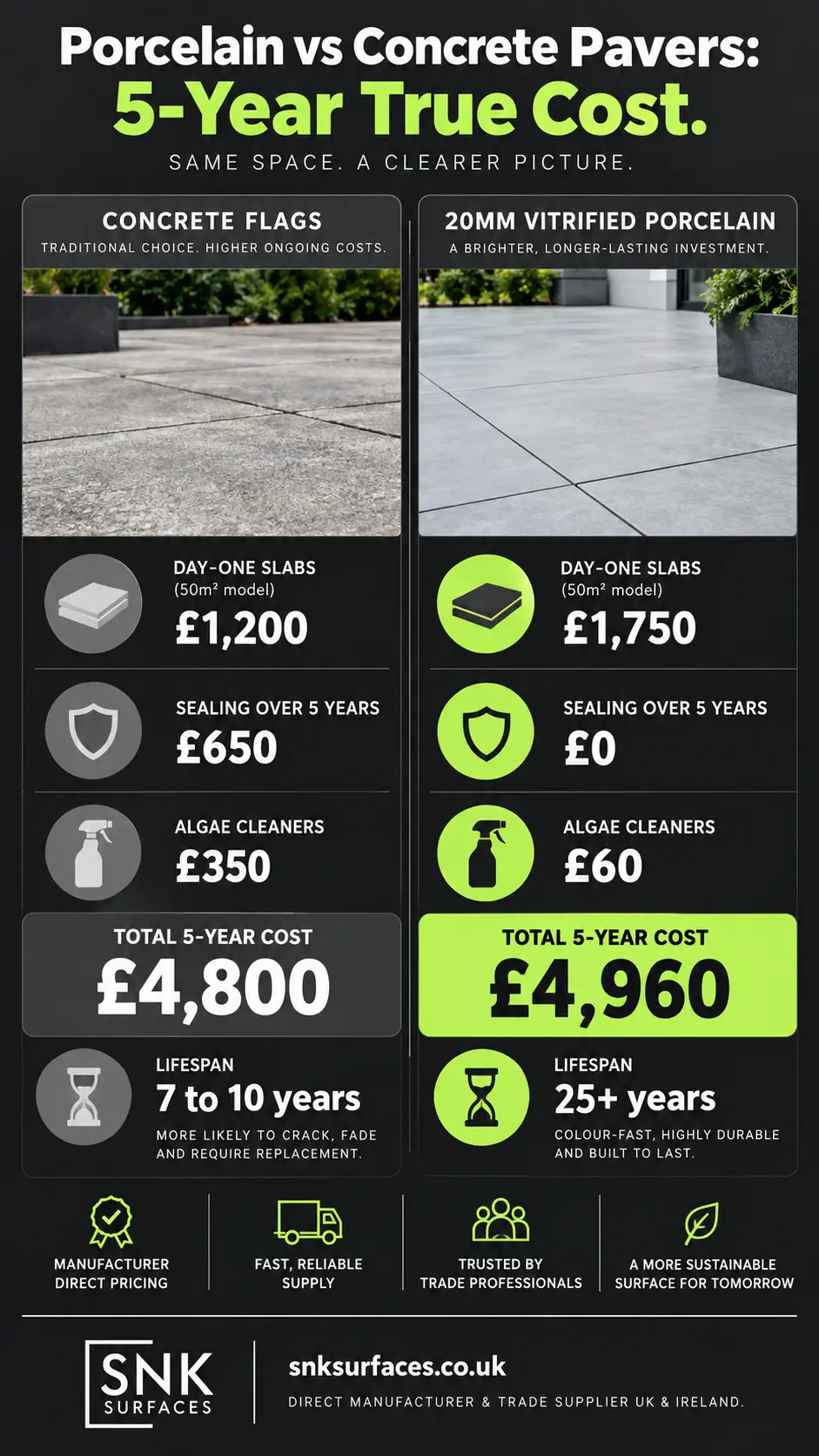
- Initial Paving Slabs: Concrete flags average £1,200 (£24/m²). Porcelain slabs average £1,750 (£35/m²).
- Groundwork and Labour: Concrete installation runs around £2,600. Porcelain installation runs around £3,150 due to full mortar bedding, primer, and diamond blade wet cutting.
- Day-One Installed Total: Concrete costs £3,800. Porcelain costs £4,900.
- Sealing Bills Over 5 Years: Concrete needs initial sealing and resealing around year three, costing roughly £650 in materials and labour. Porcelain requires £0 because it never needs sealing.
- Chemical Cleaners and Maintenance: Keeping concrete free of moss and salt bloom costs roughly £350 over five years. Porcelain needs only occasional washing with mild soap or a pH-neutral cleaner from Lithofin, costing about £60.
- Total 5-Year Cost: Concrete reaches £4,800. Porcelain sits at £4,960.
- Lifespan: Concrete typically lasts 7 to 10 years before heavy wear. Porcelain lasts 25+ years with its original colour intact.
When weighing porcelain vs concrete pavers, concrete seems to save £1,100 on day one. Yet after factoring in sealers, cleaners, and maintenance labour, the real gap after five years shrinks to just £160. By year seven, porcelain becomes the cheaper option.
Proven 20mm Vitrified Porcelain Choices
If you decide that porcelain is the smarter choice over concrete, picking the right colour tone completes your garden layout:
- County Anthracite Porcelain: A deep charcoal stone finish engineered to complement modern anthracite aluminium door frames.
- Portico Gris Porcelain: A balanced mid-grey tone ideal for contemporary garden patios and white rendered walls.
- Portico Silver Porcelain: A crisp, light silver-grey slab designed to brighten shaded gardens without blinding glare.
- Quartz Grey Porcelain: A versatile trade favourite with subtle mineral veining that hides everyday garden dust. Read our Quartz Grey technical specs guide for details.
Frequently Asked Questions
Do porcelain paving slabs crack more easily than concrete pavers?
No. In tests of porcelain vs concrete pavers, 20mm vitrified porcelain has much higher flexural strength than concrete flags. Porcelain only cracks if laid on a hollow mortar bed. Installed on a continuous 4:1 wet mortar bed, it handles heavy patio furniture and foot traffic easily.
Can I pressure wash both surfaces?
You can safely pressure wash vitrified porcelain using a medium fan-jet nozzle held at least 30cm away. Pressure washing concrete pavers is risky. High-pressure jets strip away the surface cement paste, open up deeper pores, and accelerate future algae growth.
Which handles barbecue grease better?
Vitrified porcelain wins comfortably. Because porcelain absorbs under 0.05% liquid, cooking oils and red wine wipe away easily. Concrete flags soak up grease almost instantly, leaving dark oil stains.
Can I lay these materials on a driveway?
Thick 50mm or 60mm concrete block pavers are designed for flexible driveway installations. Standard 20mm outdoor porcelain is made for pedestrian patios and garden paths. It should only be used on driveways if installed over an engineered, reinforced concrete slab using specialist exterior adhesives.
Does outdoor porcelain ever need sealing?
No. You should never apply sealers to vitrified porcelain. Sealant cannot penetrate the non-porous ceramic surface and dries into a cloudy, sticky film. Concrete flags need breathable sealers every two to three years to slow down algae and frost pitting.
Which option adds more resale value to a property?
In any comparison of porcelain vs concrete pavers, clean vitrified porcelain adds stronger buyer appeal. Buyers view low-maintenance porcelain patios as an attractive feature, whereas tired or algae-covered concrete slabs are seen as an upcoming replacement expense.
The Bottom Line on Paving Selection
Budget concrete flags work fine for shed bases, utility paths, or low-cost rental updates where long-term looks do not matter. For a main garden patio or home extension in the UK or Ireland, the verdict on porcelain vs concrete pavers is clear. Spending slightly more upfront for 20mm vitrified porcelain eliminates colour fading, salt bloom, frost damage, and ongoing sealing costs. You invest virtually the same total money over five years while enjoying a patio that looks new for decades.
For Homeowners: Order free cut samples of our porcelain collection today. Examine the colours and feel the slip-resistant R11 texture in your own garden light before making a decision.
For Landscaping Contractors and Specifiers: Remove middleman markups from your supply chain. Register for a direct trade account with SNK Surfaces Limited today to unlock trade pallet rates, technical data sheets, and fast site delivery across the UK, Northern Ireland, and the Republic of Ireland.